Trading in Turkey takes place through a substantial domestic financial system, authorised channels for international investment and an offshore market that includes both foreign-regulated businesses and unauthorised operators. The legal position changes with the instrument, the provider and the customer’s circumstances. Buying a foreign share, holding dollars in a bank account, trading a currency future and opening a leveraged forex position are different transactions, even when they express similar views about markets. Turkey permits regulated securities and derivatives trading while restricting residents’ use of unauthorised providers for leveraged forex and comparable products. Binary options, financial spread betting and crypto require additional distinctions. This article examines those differences using regulatory material and market data checked on 22 October 2026, separating what the rules permit from what the available evidence shows about actual trading behaviour.
Domestic participation remains substantial. The Turkish Capital Markets Association’s October 2026 statistical publication reports approximately 6.69 million equity investors and 5.80 million investment fund investors, alongside activity in regulated derivatives. Its figures below establish an operating domestic market, although they do not measure offshore participation. The publication also warns that active-account figures can count the same person more than once when accounts are held at several institutions. Comparing those figures directly with unique investor counts would therefore be misleading. A person may simultaneously own local shares, hold foreign securities and maintain an offshore derivatives account, with a different legal position attached to each arrangement. Neither domestic statistics nor records of blocked websites provide a complete census of traders’ compliance or establish that most Turkish trading has moved abroad.
| Measure | Reported figure | Reference period |
|---|---|---|
| Equity investors | 6,693,054 | September 2026 |
| Investment fund investors | 5,799,285 | September 2026 |
| Accounts trading equities during the month | 3,222,761 | August 2026 |
| Accounts trading on VİOP during the month | 32,841 | August 2026 |
| Accounts trading leveraged products during the month | 14,725 | August 2026 |
How Turkish trading regulation works
Turkey’s main capital markets regulator is the Sermaye Piyasası Kurulu, known as the SPK in Turkish and the Capital Markets Board, or CMB, in English. Its information on intermediary institutions provides a starting point for checking a brokerage, but the relevant question is whether the institution has permission for the activity being offered. Company registration establishes that a legal entity exists; it does not establish permission to provide investment services. Similarly, authorisation for one financial activity should not be assumed to cover every product advertised by a business. International brokerage groups can operate through several companies under a common name, making the distinction harder to see. The account agreement identifies the contractual counterparty, and that identity must correspond with the regulatory permission being relied upon. A group’s most prominent licence is not necessarily the licence governing every customer account.
Cross-border trading also falls within Turkey’s foreign exchange framework. Article 9 of the Treasury and Finance Ministry’s communiqué implementing Decree No. 32, amended in March 2025, requires residents to conduct leveraged transactions and derivatives subject to the same rules through SPK-authorised institutions. It prohibits unauthorised intermediation and overseas transfers connected with those transactions. The article also contains a conditional exception for certain other derivatives initiated entirely by residents with overseas financial institutions, where there is no marketing directed at Turkey and transfers pass through banks. That exception does not remove the separate restriction applying to the leveraged transactions covered by paragraph two. Consequently, the claim that any offshore trade becomes permissible when the customer initiates contact is too broad. The product and the applicable provision have to be identified before that argument can be assessed.
Residence creates another distinction that international readers can easily miss. Several relevant restrictions concern persons resident in Turkey, so nationality alone does not determine their application. A Turkish citizen living abroad and a foreign citizen resident in Turkey may present different regulatory questions from what their passports suggest. Residence for financial regulation and residence for tax also need separate examination. On the provider’s side, a foreign licence can be genuine without establishing permission to offer the relevant service to Turkish residents. The SPK’s warning on unauthorised leveraged transactions makes its position on resident-facing services clear. For practical purposes, the customer’s status, the contract and the institution must all be checked. A website’s willingness to accept an application answers only whether its onboarding system will open the account.
Shares, bonds, funds and foreign investments
Turkey’s investment market includes shares, government and corporate debt, investment funds, exchange-traded funds, warrants and other securities. The Turkish Capital Markets Association’s 2025 market report documents activity across these markets and records 36 intermediary institutions participating in leveraged trading during that year. This breadth matters because discussion of Turkish trading often concentrates on forex restrictions while overlooking conventional investment activity. A share represents an ownership interest, a bond creates a creditor relationship and a fund provides exposure through its portfolio and legal structure. A derivative creates contractual rights and obligations whose value depends on a reference asset or measure. These differences affect income, custody, financing and what happens if an institution fails. Similar charts or order screens do not mean that two positions provide the same rights, even when both respond to movements in the same market.
Restrictions on offshore leveraged trading should therefore not be read as a prohibition on all foreign investment. Turkey provides authorised channels for purchasing overseas securities, with availability depending on the intermediary and its permissions. Buying a foreign share through an appropriate arrangement differs from opening a CFD referencing it, just as holding dollars in a bank differs from trading a leveraged currency position. The distinction also applies to physical gold, gold funds and gold derivatives. For investors concerned about purchasing power, the chosen vehicle can introduce risks unrelated to the original objective. A fully paid holding can generally remain in place through a temporary fall in value, whereas insufficient collateral can force a leveraged position to close. An investor may eventually be correct about currency depreciation or gold prices and still lose money because the position could not survive an earlier adverse movement.
Forex trading and leverage restrictions
Retail leveraged forex is permitted within Turkey’s authorised framework, subject to requirements concerning the provider, account and leverage. The SPK’s February 2017 announcement reduced maximum leverage from 100:1 to 10:1 and introduced minimum starting collateral of TRY50,000 or its foreign currency equivalent. Current domestic broker information, including Destek Yatırım’s published forex conditions, continues to state that minimum and maximum. The starting amount is account funding, rather than an administrative fee, and remains exposed to trading losses. Its economic burden also changes over time: a fixed lira requirement does not represent a fixed proportion of income or a fixed foreign currency value. Describing the threshold as permanently high or low without reference to wages, prices and exchange rates would therefore give an incomplete account of its effect on access.
The leverage limit becomes clearer through a numerical example. A hypothetical account containing TRY50,000 can support TRY500,000 of exposure if the trader uses the whole balance at 10:1. A 1% adverse movement in a simple linear position would produce approximately TRY5,000 of losses before costs, equal to 10% of the starting account. The table illustrates how changing the exposure changes that result. These figures exclude spreads, financing, currency conversion and liquidation mechanics, which can alter the realised outcome. The maximum permitted ratio does not require a trader to use it, and a higher allowance does not improve the profitability of an unchanged position. Two traders holding the same exposure experience the same market-driven profit or loss before cost differences. Greater permitted leverage mainly allows that exposure to be funded with less collateral or expanded further.
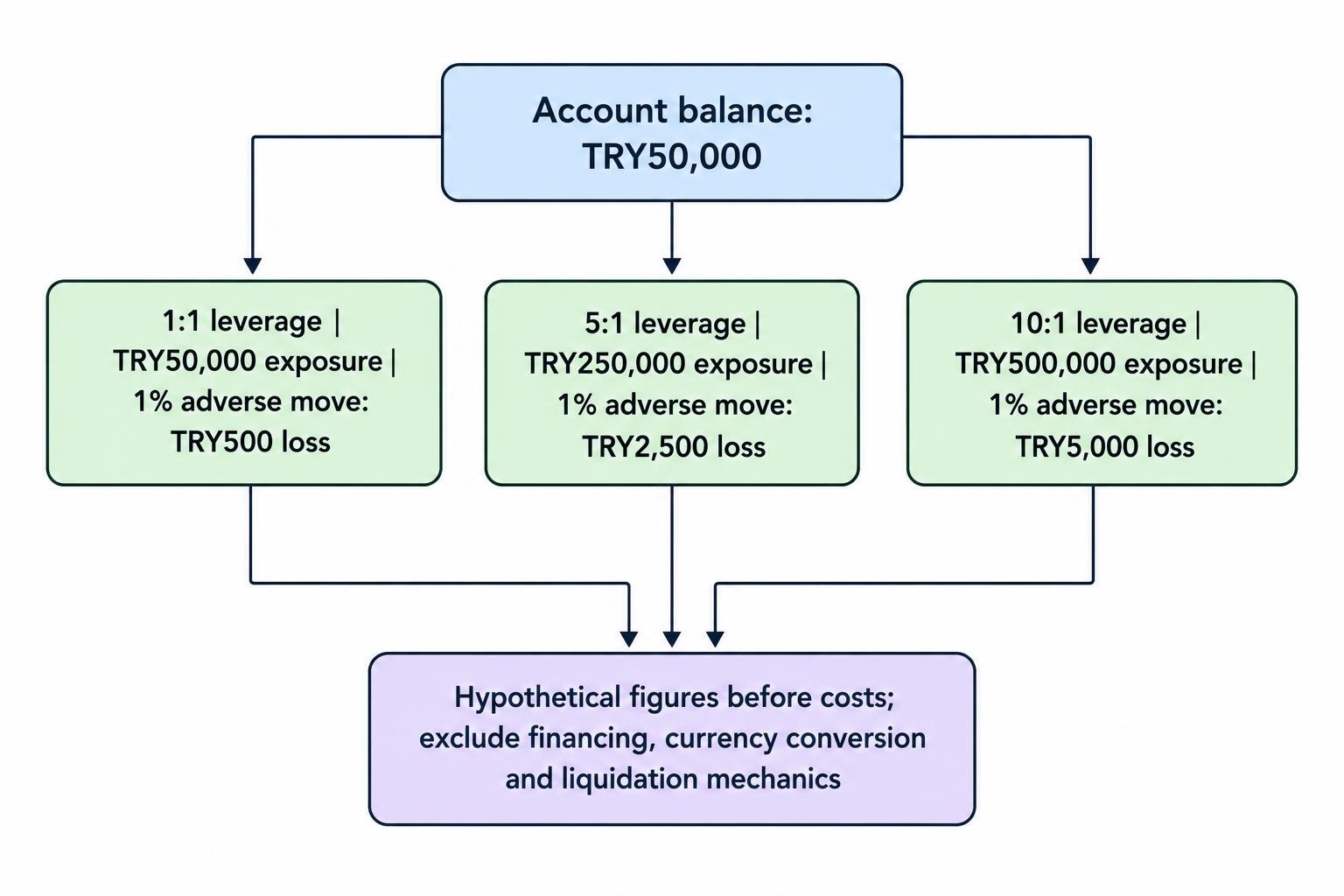
| Leverage used | Exposure supported by TRY50,000 | Loss from a 1% adverse movement |
|---|---|---|
| 1:1 | TRY50,000 | TRY500 |
| 5:1 | TRY250,000 | TRY2,500 |
| 10:1 | TRY500,000 | TRY5,000 |
Opening an account also involves more than meeting the funding threshold. The SPK’s forex investor booklet describes compulsory demo-account trading before general clients open a leveraged account, together with risk disclosures. Practice can establish familiarity with order entry and margin calculations, but it cannot demonstrate that a strategy will remain profitable when conditions change. Trading costs then affect the result throughout the account’s life. Frequent transactions repeatedly incur spreads or commissions, while positions held for longer periods may accumulate financing charges. The customer also needs to understand the circumstances in which positions are closed automatically. A forecast can be correct over several months while the account loses its capital during a much shorter adverse movement. The regulation restricts exposure, but position sizing and the ability to fund the position still determine how those risks affect an individual trader.
CFD trading in Turkey
A contract for difference provides exposure to a change in price without ownership of the referenced asset. Depending on the offering, the reference may be a currency, share index, commodity or another permitted instrument. Turkey expressly brings over-the-counter CFDs within its leveraged trading framework. The SPK’s investment services guide, updated in March 2026, explains that these contracts are subject to relevant requirements covering leverage, collateral monitoring, demo accounts, advertising and other aspects of the service. Describing a contract as international investing or commodity trading does not establish an exemption from those provisions. The trader needs to identify whether the transaction creates ownership, an exchange-traded position or a bilateral derivative. That classification affects both the legal route through which the product can be offered and the customer’s relationship with the institution providing it.
A CFD creates exposure to the underlying price and to the terms of the provider’s contract. Those terms govern pricing, financing, adjustments, trading hours and close-out procedures, so a market level displayed by a news service is not necessarily an executable quote for the customer. A cash CFD may incur overnight financing, while a contract based on a futures price can involve different expiry or rollover arrangements. Comparing advertised spreads alone therefore leaves out part of the cost of maintaining the position. The same applies when comparing a CFD with a fund tracking a similar market: directional exposure may look alike while ownership, funding and holding costs differ. An offshore platform’s acceptance of a Turkish address does not resolve any of those questions, and the use of familiar trading software provides no independent evidence that the business is authorised.
Exchange-traded futures and options
Turkey has an organised derivatives market through VİOP, Borsa İstanbul’s futures and options market. The exchange’s VİOP information describes contract categories including equities, indices, currencies, precious metals, energy and interest rates, with options categories covering shares, equity indices and USD/TRY. These instruments provide domestic routes for hedging and speculation, although a listed category does not guarantee adequate liquidity in every contract. Activity can vary substantially between products, maturities and option strikes. The existence of leverage also does not place every future in the same regulatory category as retail forex. Futures operate under their own market and product requirements, which must be examined separately. This distinction matters when comparing access or margin rules: the familiar forex limit cannot simply be applied to every instrument whose economic exposure exceeds the initial cash committed.
An exchange-traded future has defined specifications, including its size, expiry and settlement method, as set out in Borsa İstanbul’s contract specifications. Maintaining exposure beyond expiry may require closing one maturity and opening another, making the price difference between contracts and the cost of both trades relevant to returns. Conventional options introduce a different set of decisions. A call or put has a strike, expiry and payoff linked to its underlying, while its value can change with the underlying price, time remaining and expected volatility. A buyer can lose the premium paid, and a seller may face much larger obligations depending on the position and any offsetting exposure. These features are materially different from the fixed win-or-lose proposition offered by many retail binary-option websites. The shared word “option” does not establish equivalent risks or legal treatment.
Binary options in Turkey
Retail binary-option platforms commonly offer a predetermined payment if a price condition is satisfied at expiry, while an unsuccessful prediction loses the amount committed. The short explanation can conceal the importance of payout arithmetic. Suppose a hypothetical TRY100 contract produces an 80% net profit when successful and loses TRY100 otherwise. Five wins produce TRY400 in gains, while five losses cost TRY500, leaving a TRY100 loss despite a 50% success rate. The break-even rate is approximately 55.6% before other costs. This means forecasting direction more accurately than a random guess is not automatically enough to make the arrangement profitable. The expiry observation, price source and payout conditions also matter. A customer must understand who determines those inputs and how a disputed result is resolved, because the apparent simplicity of the screen does not eliminate contractual or operational uncertainty.
The SPK’s August 2017 decision stated that the betting-like binary products and services described were outside the capital market instruments and activities covered by the Capital Markets Law, and warned about absent regulatory supervision and difficulties obtaining redress. That position should not be interpreted as approval to operate without restrictions. An earlier June 2012 bulletin records referrals concerning named websites under the criminal-law provision addressing the provision of facilities for gambling, alongside requests for access restrictions. These decisions concern the specified retail offerings and operators; they do not establish that conventional listed options are prohibited or that every customer has identical liability to an operator. For a prospective user, the relevant conclusion is that such binary websites should not be presented as ordinary SPK-authorised investment services merely because they display financial prices or claim an overseas licence.
Financial spread betting in Turkey
Financial spread betting allows a customer to stake an amount per point of market movement. A position of £5 per point, for example, gains or loses £500 when the relevant market moves 100 points, before costs. Its payoff therefore differs from a binary contract’s fixed payment for satisfying a condition. It is also distinct from the bid–ask spread encountered in ordinary trading: paying a spread does not make a transaction financial spread betting. The UK Financial Conduct Authority includes financial spread betting and rolling spot forex within its discussion of retail CFD products, explaining why British providers often present them together. That classification is useful for understanding the product, but it does not establish permission to offer it in Turkey or determine the obligations of a Turkish resident.
The official Turkish materials reviewed for this article do not establish a separate authorised retail spread-betting route comparable to the British offering. A proposed contract would need to be assessed against the relevant Turkish rules, so presenting it as an established workaround for leveraged trading restrictions would be misleading. The same caution applies to promotional claims about tax-free profits. Those claims often depend on the customer’s jurisdiction, residence and circumstances, and cannot be transferred automatically to people living elsewhere. A change of product label does not itself change the economic exposure or settle the legal classification. Customers should also distinguish financial spread betting from betting on sporting events, since an apparently similar staking mechanism does not establish identical regulation. The contract, provider and applicable jurisdiction remain the basis for assessment.
Cryptocurrency trading in Turkey
Turkey has developed a dedicated framework for crypto service providers, which needs separate consideration from conventional securities and forex. The SPK’s March 2025 announcement describes two implementing communiqués following the 2024 legislative changes that brought those providers under its authority. Within that framework, buying an asset outright differs from opening a leveraged derivative. Article 14 of the CMB’s crypto operating communiqué prohibits the platforms it governs from offering leveraged trading in listed crypto assets and from subjecting them to the specified derivative, margin, short-selling and lending transactions. A domestic spot account should therefore not be assumed to carry permission for perpetual futures available through an international affiliate. Shared branding can conceal separate contracts, asset custody arrangements and regulatory positions.
Cross-border crypto services also have their own provision. Article 9 of the same communiqué contains a conditional exclusion for services obtained entirely on a resident’s own initiative from an overseas provider that does not target Turkey. A Turkish website or locally directed promotion can change that assessment, and the exclusion does not create a blanket exemption from every other applicable rule. Separately, the SPK’s list of operating crypto providers expressly states that inclusion does not itself mean the institution has been authorised under the relevant legislation. This distinction matters when evaluating a claim that a platform is “approved”. An application, transitional operating status and completed authorisation are different things. The customer needs to establish which status applies to the exact institution holding the account and whether it covers the service being used.
Crypto payments create another issue that is sometimes confused with permission to hold or trade an asset. The central bank’s regulation on crypto assets in payments prohibits their direct or indirect use in payments, which is different from a blanket prohibition on ownership. An offshore trading platform’s ability to receive a crypto transfer does not consequently prove that its funding arrangement complies with Turkish requirements. The transfer also changes the practical recovery problem if the provider fails to credit the account or refuses a withdrawal. A transaction record may establish that assets moved to a particular address without establishing the recipient’s solvency or willingness to return them. Technical transferability, permission to provide the underlying service and the customer’s ability to enforce a claim remain separate questions.
Why some Turkish traders use offshore platforms
There is documented unauthorised offshore activity directed at Turkish residents. The SPK’s April 2025 enforcement bulletin, for example, identifies websites offering unauthorised overseas leveraged trading and records decisions to pursue access restrictions. The commercial incentives for seeking foreign accounts are understandable. Higher advertised leverage can appeal to customers wanting greater exposure from a small deposit, while lower entry requirements may attract those unwilling or unable to fund a domestic account at the required level. Other possible attractions include a wider product menu, familiar software or an existing international brokerage relationship. These are plausible explanations based on differences in account conditions, rather than a measured ranking of Turkish customers’ motivations. They also carry a financial trade-off: an account opened with less money may support a position that is much less able to withstand ordinary market fluctuations.
The term “offshore broker” covers materially different businesses. An overseas institution may have substantive supervision in its home jurisdiction while lacking permission for the relevant Turkish activity; another may face weaker oversight, and a fraudulent website may have no genuine brokerage operation behind it. Customers can also arrive through different paths. Some may knowingly prefer foreign conditions, while others misunderstand the relevance of a foreign licence, misidentify the contracting company or are misled about the product. The FCA’s customer information warns about overseas firms using names similar to authorised UK businesses or sharing trading names, illustrating why a brand check is insufficient. Evidence that residents use offshore services therefore does not establish that every customer knowingly disregards the law. That would be a separate claim about their awareness and intention, requiring evidence beyond the location of the account.
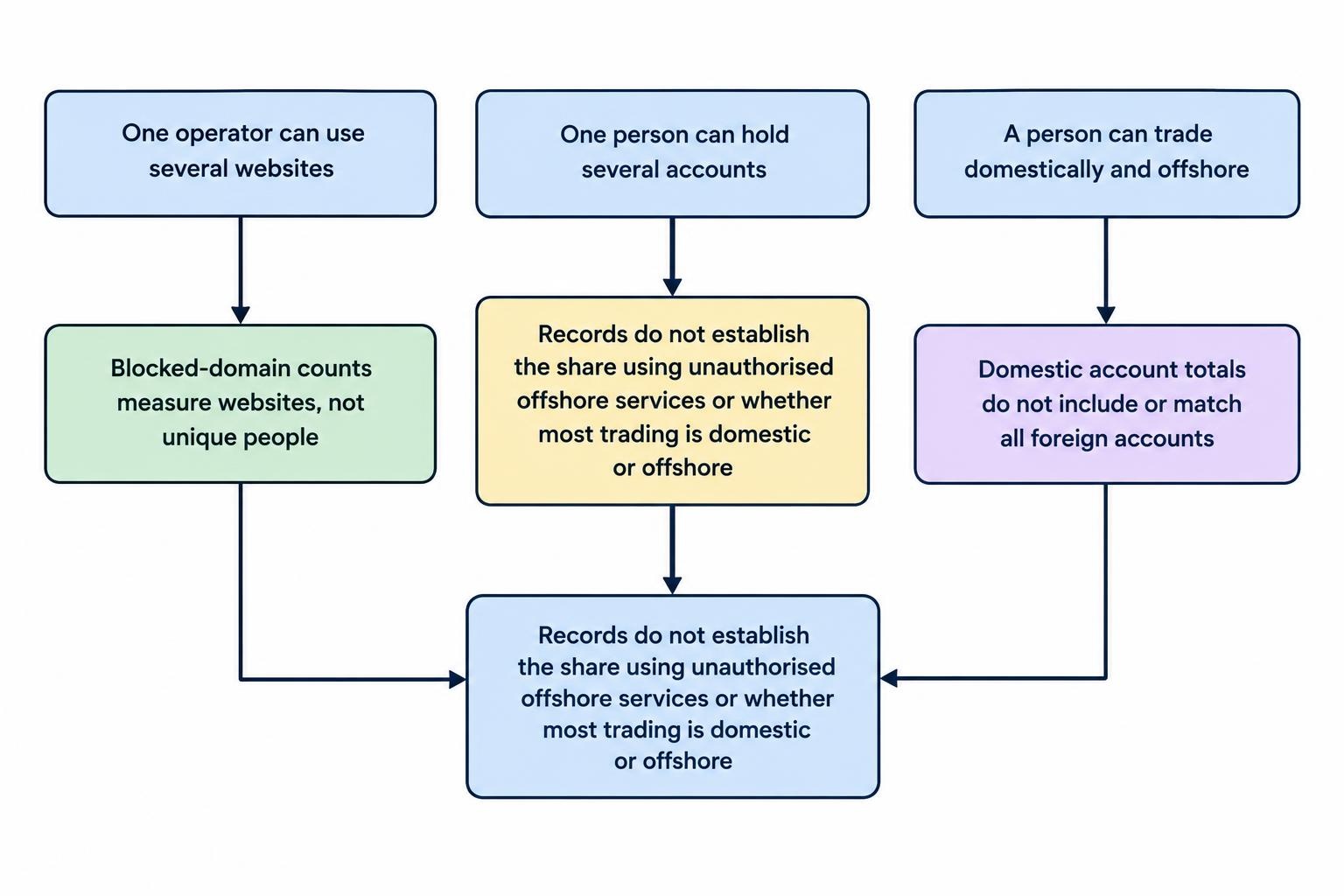
Nor do enforcement records establish that offshore trading dominates. One operator can use several websites, one customer can hold several accounts, and the same person can trade both domestically and abroad. Counting blocked domains cannot therefore produce a reliable percentage of traders using unauthorised services. Domestic account statistics cannot supply the missing denominator because they do not identify all foreign accounts or match them to unique individuals. Trading volume would introduce further problems: leveraged turnover can be very large relative to deposits, and frequent trading can make a small group appear economically larger than a much wider population of occasional investors. The available evidence establishes a substantial regulated market alongside persistent unauthorised activity. It does not support a precise claim that most traders comply, most evade restrictions or most have moved offshore, and broker marketing should not be treated as a substitute for that missing measurement.
Enforcement and investor protection
Turkey’s restrictions are supported by enforcement against unauthorised services and people facilitating them. The SPK’s February 2023 warning describes complaints involving telephone approaches, high-return promises and requests to transfer money to domestic bank accounts for unauthorised forex services. It also addresses assistance through advertising and the use of bank accounts or telephone lines. Operating a service, promoting it and trading as its customer are different forms of conduct, so penalties directed at operators should not automatically be attributed to every investor. Equally, that distinction does not establish that the customer’s transaction is permitted. A proper assessment requires the conduct and the relevant provision to be identified. General statements that customers always face criminal prosecution, or that only brokers can ever face consequences, go beyond what these materials establish.
Local payment details can make a foreign operation appear domestically supervised, but a Turkish bank account does not establish investment-services authorisation. The recipient should be consistent with the documented account arrangement, and unexplained transfers to individuals or unrelated businesses raise a further question about who controls the money. A professional trading interface provides equally little evidence about custody or execution. It can display prices, positions and profits without independently proving where funds are held or which market transactions occurred. The customer’s evidence is the legal agreement, verified institutional identity, account documentation and transaction records. These become particularly relevant when a withdrawal is delayed or the provider says additional payments are required. A displayed account balance is a record produced by the platform; its practical value depends on whether the customer has an enforceable claim and can actually receive the funds.
Investor compensation also has a defined purpose. Turkey’s Investor Compensation Centre explains that it implements compensation decisions where investment institutions cannot meet covered obligations to pay cash or deliver capital market instruments. Its description of its legal role concerns those failures, rather than reimbursement whenever an investment loses value. Customers should therefore separate market risk from an institution’s failure to meet its obligations. With an overseas provider, recovery introduces further questions about the governing law, the forum for a dispute and the location of accessible assets. Obtaining a favourable decision and enforcing it may be separate processes with separate costs. Foreign regulation can be relevant to that assessment, but it should be checked against the actual contracting entity and eligible customer category. The strongest protection advertised elsewhere within a group may have no application to the account in dispute.
How to assess a trading arrangement
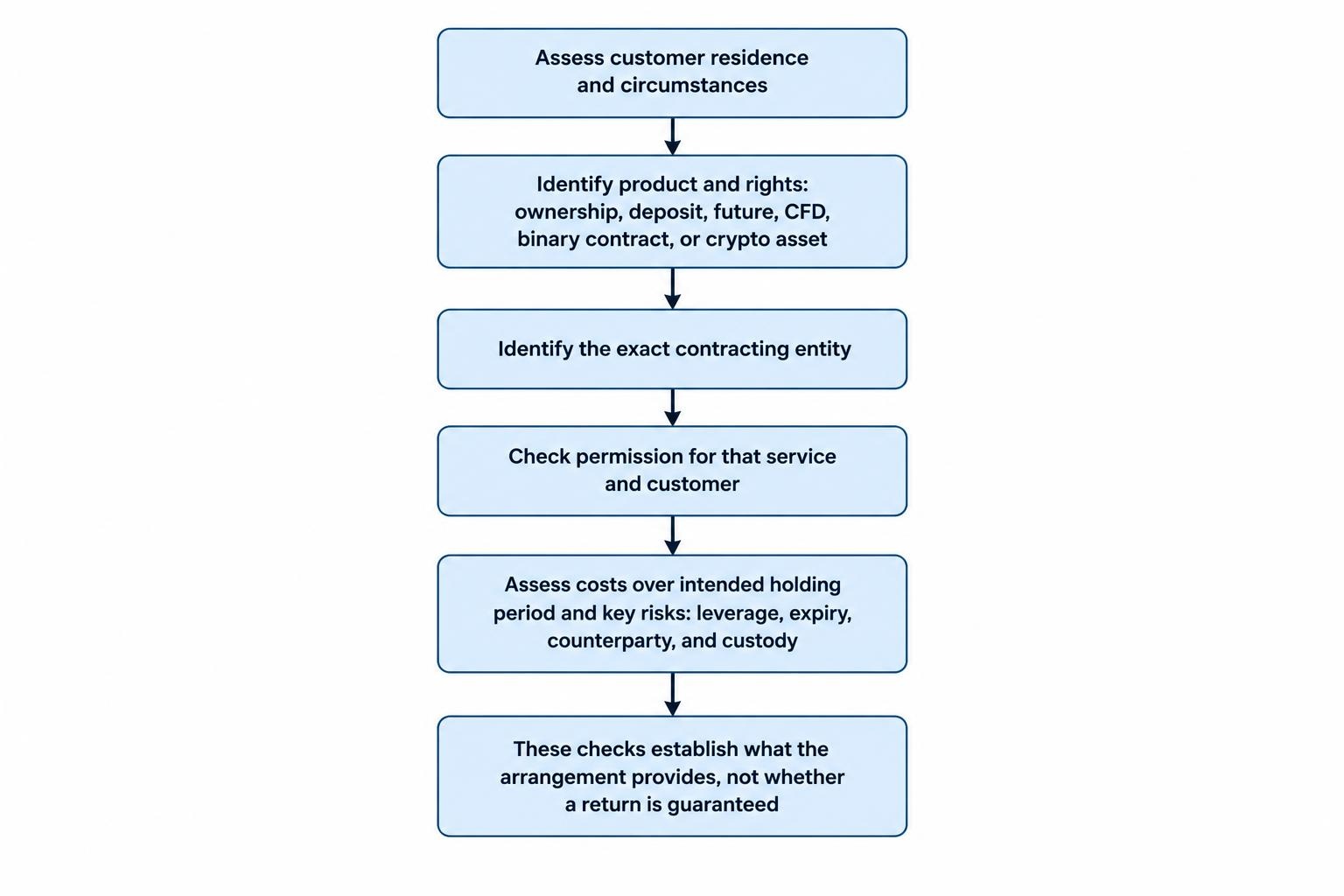
Assessment begins with identifying the actual position and the institution responsible for it. A share, fund unit, bank deposit, future, CFD, binary contract and crypto asset can all appear in an investment application while creating different rights and funding obligations. The legal entity in the agreement should match the permission being relied upon, and the customer’s residence should be considered separately from nationality. Costs then need to be assessed over the intended holding period, since a narrow advertised spread can be outweighed by financing, conversion, rollover or execution costs. This approach also helps distinguish market access from suitability for an objective. A product may provide the desired price exposure while introducing expiry, leverage or counterparty obligations that the investor did not intend to assume. Understanding those obligations is part of determining what the account actually provides.
Returns and records require the same attention. A hypothetical investment rising 20% in lira while the lira loses 25% against the investor’s reporting currency produces a combined return of negative 10% before costs: 1.20 multiplied by 0.75 equals 0.90. The platform’s local-currency profit therefore cannot establish the investor’s economic result on its own. Records should identify the contracting entity, product, deposits, withdrawals, transaction dates, charges and relevant currency conversions. Where residence changes, the dates and circumstances should also be documented because regulatory and tax questions may depend on them. These records allow the investor to establish what was held, where the account was maintained and how the result was calculated. They also provide the factual basis for a later complaint or dispute, which a headline balance or screenshot of a profitable trade cannot supply.