Swing trading in Turkey involves holding positions for several days or weeks to capture part of a price move. It can be applied to Turkish shares, exchange-traded funds, futures and other instruments, but the holding period does not determine the rules governing the trade. A share bought outright on Borsa İstanbul behaves differently from a leveraged currency position or an expiring futures contract. The practical task is to connect the trading idea with an appropriate instrument, a realistic exit and a manageable cash exposure. Turkey adds further considerations through lira movements, monetary policy and exchange trading restrictions. A chart may show an attractive opportunity while the actual transaction carries funding, liquidity or currency risks that are not visible in the price pattern.
The approach sits between intraday trading and longer-term investing, although those boundaries are approximate. Charles Schwab’s explanation of swing trading describes positions intended to capture movements over days or weeks, with overnight exposure forming part of the risk. For background on the methods involved, SwingTrading.com’s swing trading guides and strategy resources provide material on trading approaches and different markets. Applying any method in Turkey requires a further assessment of local execution and account conditions. A strategy developed using another exchange’s data may assume different trading hours, borrowing arrangements or order behaviour. The relevant question is whether its rules remain workable for the instrument actually being traded, after allowing for transaction costs and occasions when an intended exit cannot be completed.
Regulation, Accounts and Market Access
Swing trading describes a trading style rather than a separate class of financial product. In Turkey, the regulatory questions concern the instrument, the service being supplied and the institution providing it. For a domestic securities account, the Capital Markets Board’s intermediary institution register is a starting point for checking the broker’s identity and permissions. A company’s trading name should match the legal entity in the agreement, and permissions should cover the intended activity. Access to share dealing does not automatically establish access to derivatives, margin trading or every foreign market. The account terms should also explain custody, trading channels and withdrawal arrangements. For an investor outside Turkey, the relevant access route may involve an intermediary in their own jurisdiction, making the custody chain and actual product equally relevant.
Account records deserve attention once access is established. Turkey’s central securities depository, MKK, provides an e-Investor service through which investors can monitor accounts, transactions and corporate actions recorded in its systems. That can help reconcile holdings with broker statements, subject to the account and custody arrangement involved. The distinction between owning a Turkish share and trading a derivative referencing it should be clear before money is committed. A foreign platform displaying a familiar company name may offer a CFD rather than the share itself. Different rights, costs and counterparty arrangements follow from that choice. Documents showing the instrument, quantity, execution price and legal counterparty provide a better account of the position than the appearance of a ticker on a mobile application.
Instruments Available to Swing Traders
Shares and Exchange-Traded Funds
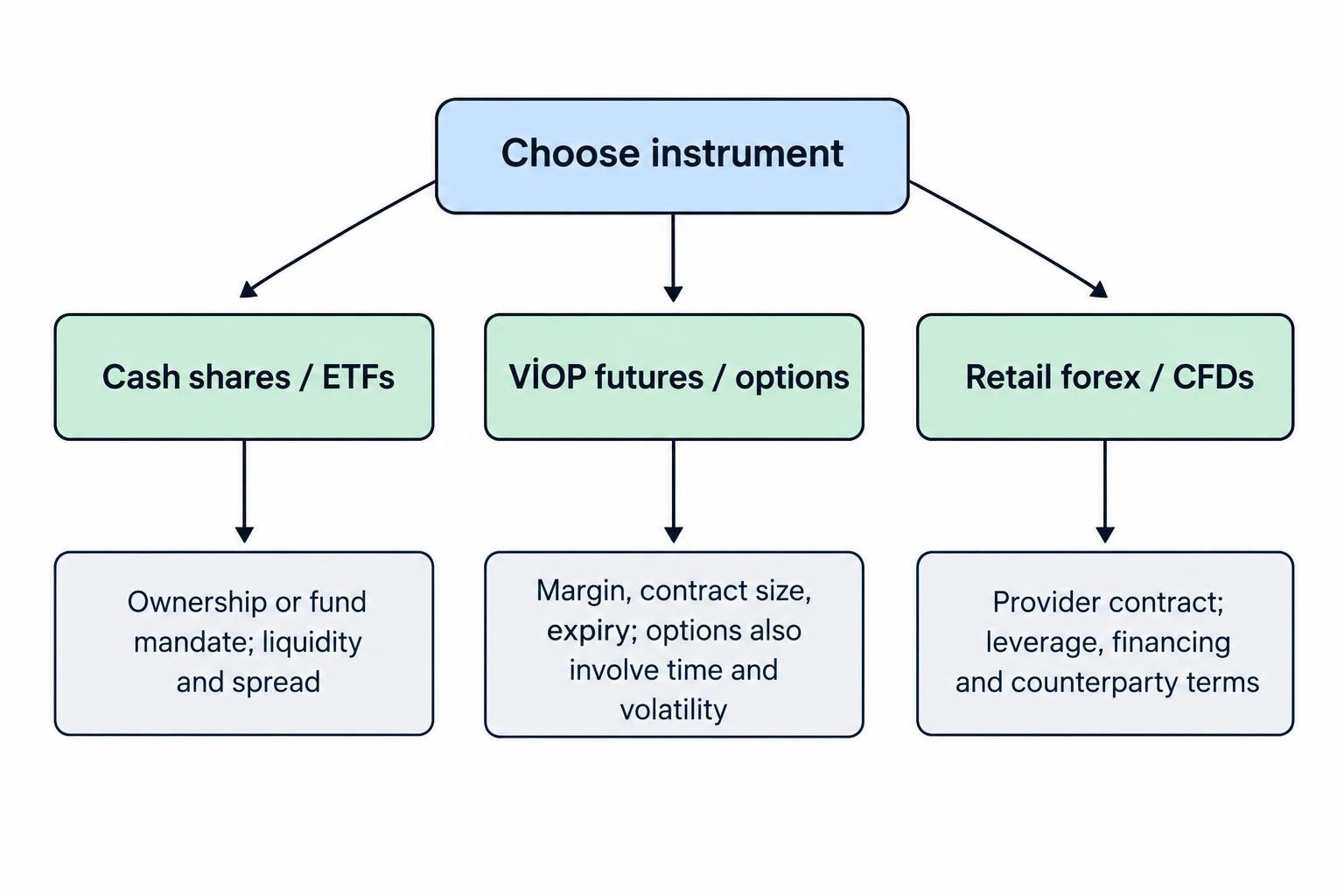
Borsa İstanbul’s equity market overview identifies shares, exchange-traded funds and several other listed instruments among the products traded on the market. Cash shares offer a relatively direct connection between the quoted price and the value of a position: 250 shares rising by TRY 2 produce TRY 500 of gross price appreciation. An ETF can provide exposure to a basket or another defined underlying investment, but its mandate and holdings need examination. A sector fund can remain heavily concentrated even when it contains several companies. Trading liquidity also matters separately from the attractiveness of the underlying exposure. A fund with a suitable theme may still have a spread or order book that makes frequent entry and exit expensive.
Futures and Options on VİOP
Borsa İstanbul’s derivatives market, VİOP, provides futures and options, with terms set out in its contract specifications. Futures introduce contract multipliers, expiry dates and margin requirements that must be incorporated into the position calculation. The amount deposited as margin is not the position’s full economic exposure. Ak Yatırım’s VİOP explanation also describes the daily reflection of profits and losses in accounts, which matters when a trade moves against the holder before recovering. An investor may need additional funds while the position remains open. Options add sensitivity to time remaining and expected volatility, so correctly forecasting direction may still produce an unsatisfactory result. For either instrument, the holding plan must fit the contract’s expiry and settlement arrangements.
Forex and CFDs
Retail leveraged forex and CFDs require a separate assessment from cash shares or exchange-traded futures. Turkey’s forex framework includes a maximum leverage ratio of 10:1 and minimum initial collateral of TRY 50,000 or its currency equivalent, as established in the SPK’s forex rule amendment. Those figures should not be transferred to an ordinary share account or assumed to describe VİOP requirements. Holding a leveraged contract for several weeks also gives financing charges time to accumulate. The broker’s swap schedule, spread and close-out rules therefore form part of the strategy itself. A forecast of gradual currency appreciation can be directionally correct while producing a poor net result after financing, or while suffering a forced closure during an interim adverse move.
| Instrument | How exposure is obtained | Main consideration for a swing trade |
|---|---|---|
| Cash shares | Ownership of company shares | Company news, liquidity and overnight gaps |
| ETFs | Units in a fund with a stated mandate | Holdings, concentration, spread and tracking |
| VİOP futures | Standardised contracts supported by margin | Contract size, daily cash demands and expiry |
| Options | Rights or obligations under an option contract | Time decay, volatility, liquidity and exercise terms |
| Retail forex and CFDs | Contracts with a trading provider | Authorisation, financing, margin and counterparty terms |
Lira Returns, Inflation and Currency Exposure
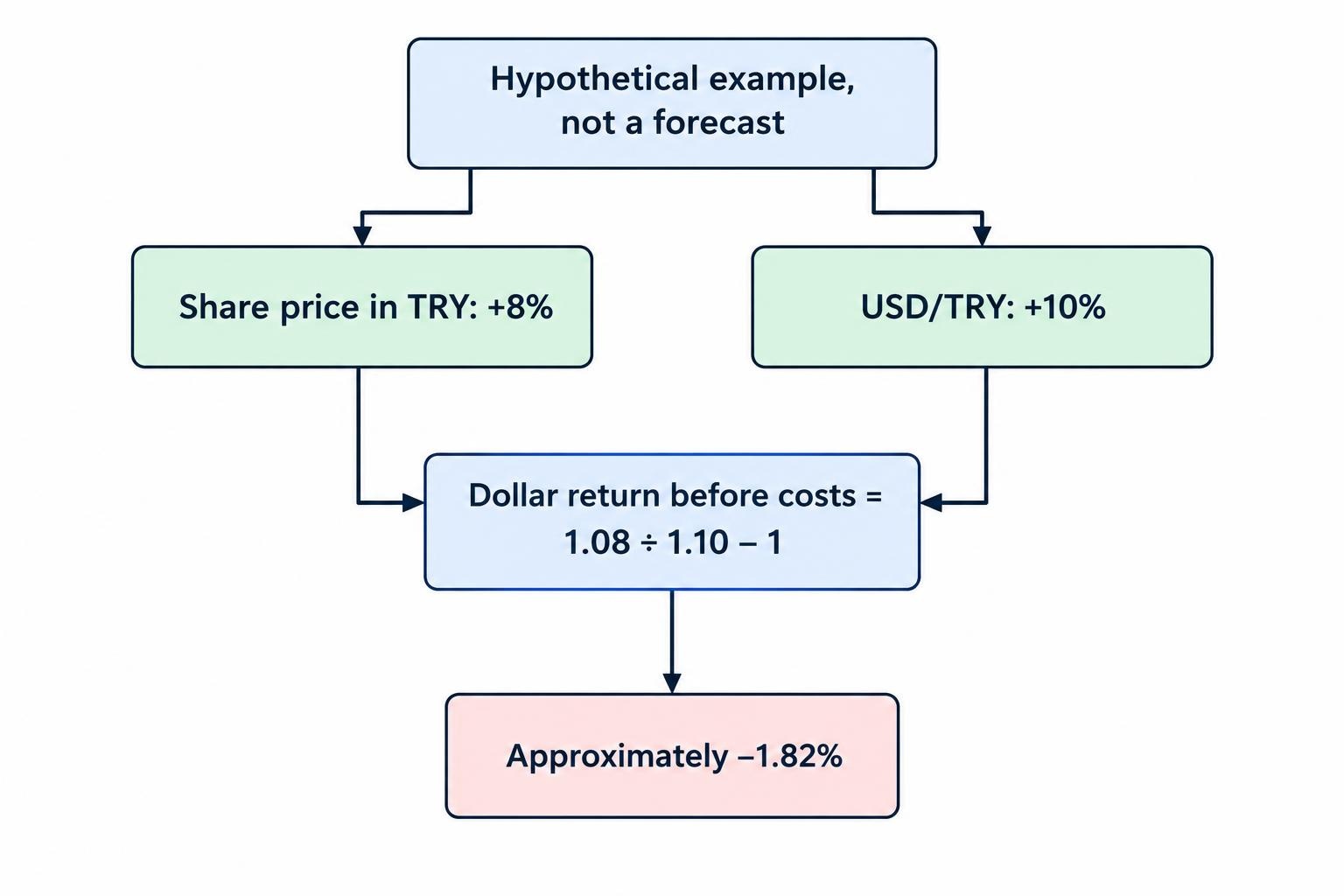
A profitable trade in lira is not automatically profitable in another currency. Suppose a Turkish share rises by 8% during a holding period while USD/TRY rises by 10%. Before costs, a dollar-based investor’s return is approximately 1.08 divided by 1.10, minus one, or negative 1.82%. The share has appreciated in its quoted currency, but each lira converts into fewer dollars at the end. These are hypothetical movements, not a forecast for Turkish assets. The same principle applies to a resident who evaluates savings against a foreign currency benchmark. Recording only the percentage change on the share chart can hide part of the economic outcome. Currency conversion spreads and transfer charges can then reduce the converted result further.
Inflation creates a different comparison. A nominal gain measures the increase in the money value of the account; a real gain considers what that money can buy. If an account rises by 5% over a period when an appropriate price measure rises by 3%, the real return is approximately 1.05 divided by 1.03, minus one, or 1.94%, before taxes. Short swing trades do not require a new inflation forecast for every entry, but repeated results should be assessed consistently over longer periods. A rising account balance can still represent weak progress in purchasing power. It also needs comparison with the return available on the trader’s chosen cash benchmark over the same dates, using comparable assumptions about tax, access and risk.
Monetary policy affects both these calculations and the companies being traded. The CBRT’s monetary policy framework explains the central bank’s price stability objective and use of policy rates and other instruments. Changes in borrowing costs can alter financing conditions, demand and the relative appeal of cash versus equities. Currency movements can also affect companies differently depending on their revenues, imported inputs and foreign currency liabilities. An exporter is not automatically protected against lira weakness if costs or debt rise at the same time. For swing trading, the immediate issue is often how an announcement differs from expectations. A policy decision that appears supportive in isolation can still be followed by falling prices if investors had anticipated a more favourable outcome.
Selecting Turkish Stocks and Checking Catalysts
A useful watchlist starts with instruments that can accommodate the intended trade size. Average turnover is helpful, but the current spread and available order depth also matter. A share can trade actively during a news event and become much harder to exit several sessions later. Larger, regularly traded companies can provide a practical starting universe, although membership of a well-known index does not guarantee an orderly exit. Selection should connect liquidity with the strategy’s expected holding period and price movement. A stock that regularly moves 4% but costs a substantial fraction of that amount to enter and leave offers a different proposition from its chart alone. The relevant liquidity is what may be available when the position needs closing, including during adverse conditions.
Company information should be checked through Turkey’s Public Disclosure Platform, KAP, which carries financial statements, material event disclosures and corporate action announcements. A planned five-day trade can overlap an earnings release, dividend event, capital increase or other announcement that changes its risk. A trader using charts does not need to build a full valuation model for every position, but should know whether a scheduled event could overwhelm the technical setup. The position can then be sized and managed with that event in mind. Reading the underlying disclosure also helps distinguish an actual corporate development from a social media interpretation. A headline about a contract, investment or financing arrangement may omit conditions that materially change its relevance to shareholders.
Chart preparation also requires attention to corporate actions. A cash dividend, share split or capital adjustment can change the displayed price without representing the same economic movement as ordinary buying or selling. Historical charts may be adjusted differently across data providers, which can move apparent support levels or alter indicator calculations. Before testing a strategy, the trader should know whether the data include such adjustments and whether returns account for cash distributions. Otherwise, a backtest can classify an ordinary adjustment as a breakout, collapse or unusually successful signal. The same care applies to futures charts assembled from successive contracts, where a change from one expiry to another can create a price discontinuity. Data preparation is part of assessing the trade, not an administrative step after the analysis.
Swing Trading Strategies in Turkish Markets
Buying Pullbacks Within an Established Trend
A pullback strategy looks for a temporary decline within a broader rising trend, followed by evidence that buying has resumed. One possible research rule could require a rising medium-term average, a retreat towards a previous trading area and a close above the prior session’s high before entry. These conditions are an example to test, not evidence of a profitable method. The exit logic should explain what would invalidate the interpretation that the decline was temporary. In a Turkish share, a pullback after ordinary profit-taking may behave differently from one caused by a financing problem or an unexpected disclosure. The chart alone cannot establish which explanation is correct. The trader therefore needs both a repeatable price rule and a reason to exclude events that change the nature of the position.
Trading Breakouts
A breakout strategy enters when price moves beyond an area that previously contained trading. The central problem is distinguishing a sustained repricing from a brief move that quickly reverses. A testable method might require a closing price above a defined range and sufficient turnover to support the intended order. Waiting for the close changes the entry price and can increase exposure to the next opening gap, so confirmation is not free. On Borsa İstanbul, a share approaching its daily price limit may also present a different execution problem from an unrestricted-looking chart pattern. An order can remain unfilled despite strong reported demand. Results should therefore be measured using plausible executable prices, rather than assuming every move through a drawn level would have produced an immediate fill.
Trading Ranges and Reversals
Range trading seeks to buy near an area where declines have repeatedly stalled and sell closer to an area where advances have weakened. It depends on the range remaining relevant, which is precisely what a new event can invalidate. A support level is a record of earlier transactions, not an obligation on future buyers. An oscillator showing an oversold condition can help describe recent price behaviour but does not establish that a rebound is due. In Turkey, a broad repricing associated with monetary policy, currency movements or market confidence can break several apparently stable ranges together. A range strategy should therefore include a clear failure condition and rules for standing aside when behaviour changes. Repeatedly increasing a losing position converts a bounded trade idea into growing exposure to a failed assumption.
Position Sizing and a Worked Example
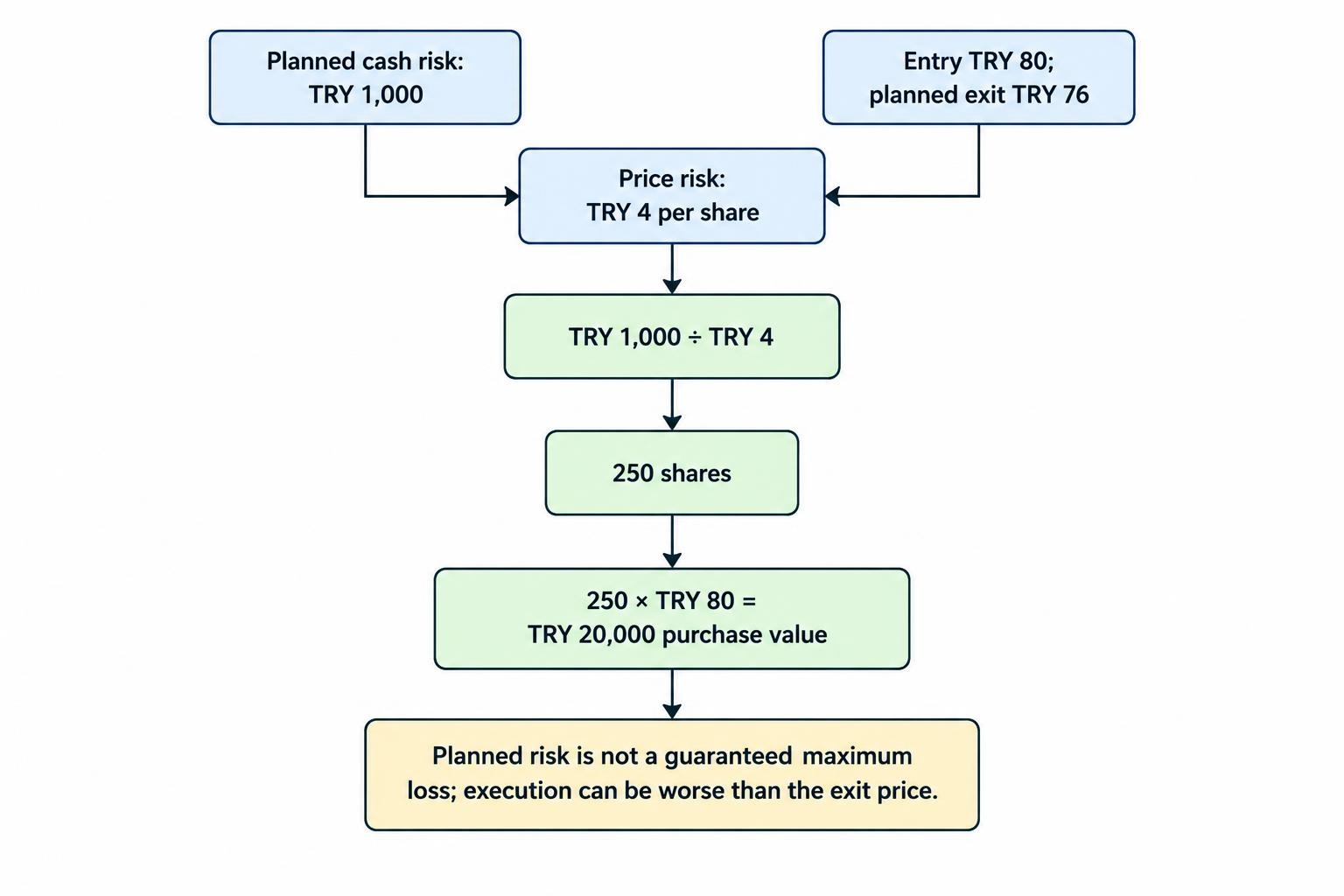
The cash amount at risk should be calculated before choosing the number of shares or contracts. CME Group’s position sizing explanation links the planned stop distance with the amount the account can allocate to the trade’s risk. Consider a hypothetical TRY 200,000 account with an illustrative planned loss of TRY 1,000. Buying at TRY 80 with an intended exit at TRY 76 creates TRY 4 of price risk per share. Dividing TRY 1,000 by TRY 4 gives 250 shares, costing TRY 20,000 before fees. The position uses 10% of the account’s capital, while the intended price loss is 0.5% of the account. Those are different measures, and neither makes the loss certain because execution can occur beyond the planned exit.
| Hypothetical trade assumption | Amount |
|---|---|
| Account value | TRY 200,000 |
| Entry price | TRY 80 |
| Planned stop price | TRY 76 |
| Position size | 250 shares |
| Purchase value | TRY 20,000 |
| Intended price loss at TRY 76 | TRY 1,000 |
| Gross gain if sold at TRY 88 | TRY 2,000 |
| Gross loss if sold at TRY 70 after a gap | TRY 2,500 |
The example’s target offers twice the intended price risk, but a two-to-one ratio does not establish profitability. The probability of reaching each exit, the size of occasional larger losses and the costs of execution all affect the result. Wider stops also require smaller positions if the planned cash loss is to remain unchanged. A volatility measure can help assess whether the proposed distance is unusually narrow relative to recent movement. Fidelity’s guide to Average True Range explains an indicator that measures trading range rather than forecasting direction. It can inform a position calculation, but cannot identify a universally correct stop. An instrument may also be too large in its minimum tradable unit to fit the account’s intended risk allowance, in which case the trade does not fit.
Portfolio exposure needs the same attention as individual position size. Buying several Turkish banks, or several companies sensitive to the same exchange rate move, can create a concentrated economic bet despite the different stock names. The sum of planned losses assumes that exits remain executable and says little about what happens when several positions gap together. A trading plan should therefore consider total exposure to sectors, common announcements and broad market declines. Margin-funded positions add another connection because losses in one position may reduce the collateral supporting others. A trader who can explain each individual chart may still have an account whose combined exposure is poorly understood. Reviewing the portfolio before adding another trade can reveal that the new position repeats an existing risk rather than introducing a separate opportunity.
Orders, Price Limits and Settlement
Borsa İstanbul uses daily price limits and circuit breakers, as described in its equity market investment guide. These mechanisms affect how a position can be entered or closed when prices move sharply. A lower price limit does not guarantee that buyers will absorb all sell orders at that level, and a trading interruption can delay an exit. The same guide currently describes equity settlement on a T+2 basis, meaning two business days after the trade. Settlement timing should not be confused with a compulsory two-day holding period, but it matters for cash availability and funding obligations. Broker buying power can differ from settled cash available for withdrawal. A swing trader needs to know which balance the platform is displaying before using sale proceeds elsewhere.
Order labels also require examination. The SEC’s explanation of order types describes the general distinction between price-controlled limit orders and stop orders that become market orders after triggering. For a Turkish account, the broker must explain which orders it supports and how any conditional stop operates in that market. A stop may be monitored through the broker’s system rather than resting as the same type of order at the exchange. Trigger prices, valid sessions and treatment during auctions or interruptions can consequently matter. A stop-limit instruction can control the acceptable execution price while leaving the position open if no trade is available within that limit. The existence of an exit instruction should never be treated as proof that the position has a guaranteed maximum loss.
Short Selling, Trading Restrictions and Offshore Accounts
A strategy designed to trade both rising and falling prices needs a workable route for each direction. Short selling shares requires more than pressing a sell button: the instrument must be eligible, borrowing and settlement arrangements must be available, and current restrictions must permit the transaction. Borsa İstanbul’s market functioning rules describe measures that can include prohibitions on short selling and margin trading, gross settlement and changes to order handling. Their application should be checked for the relevant security and date. Gross settlement can require the buyer to hold the corresponding cash and the seller to hold the corresponding shares. These conditions can invalidate assumptions made by a strategy tested under ordinary net settlement or unrestricted short-selling conditions.
An overseas platform does not make those questions disappear. For Turkish residents, the Treasury communiqué under Decree No. 32 contains rules governing foreign securities and derivatives transactions, with a separate restriction for leveraged transactions and derivatives subject to the same provisions. Article 9(2) requires those leveraged transactions to pass through SPK-authorised institutions and prohibits overseas transfers for the unauthorised transactions it covers. Calling the activity swing trading does not change its legal classification. Nor should every foreign investment be grouped together with offshore retail forex. The product, residence, intermediary and funding route need to be assessed together. A broker accepting an application shows commercial willingness to open the account; it does not establish that the proposed activity complies with all relevant requirements.
Costs, Financing and Tax Records
Swing trading usually involves fewer transactions than an intensive intraday approach, but its costs can still consume a meaningful share of gross profits. Suppose a hypothetical cash share purchase costs TRY 20,000 and the broker charges 0.10% on each side. Entry commission would be TRY 20. If the position were sold for TRY 22,000, exit commission would be TRY 22, leaving TRY 1,958 of the TRY 2,000 price gain before other charges and taxes. These are invented fee assumptions for arithmetic, not a quotation from a Turkish broker. Spread and slippage create further costs that may not appear as separate lines on the statement. Comparing a strategy’s average gain with its total round-trip cost is more informative than comparing advertised commission rates alone.
Holding period becomes more consequential when the position uses borrowed money or a financed derivative. Margin interest, stock borrowing charges and CFD financing can continue while a trade waits for its expected move. Currency conversion adds another cost when account funding, trading and eventual spending use different currencies. A method tested using cash shares cannot be assumed to produce the same result when implemented through a leveraged contract. Tax treatment also depends on the instrument, investor and applicable rules rather than the label swing trading. Keep transaction statements, distributions, fee records and evidence of any withholding so the taxable result can be established for the relevant jurisdiction. A claim that one category receives favourable treatment should not be extended automatically to derivatives, foreign holdings or another investor’s residence.
Research, Testing and the Daily Routine
A manageable process begins with a defined universe and a small number of written setups. After reviewing open positions, the trader can check KAP disclosures, upcoming company events and the monetary policy calendar before assessing new candidates. Entry conditions, position size and intended exits should be recorded while the outcome is still unknown. This reduces the temptation to describe an unplanned purchase as a strategy after it happens to rise. It also makes missed trades and rejected candidates useful records rather than forgotten possibilities. For someone trading Turkish markets from another time zone, the routine must fit the exchange’s sessions and the broker’s support hours. Price alerts can assist monitoring, but they cannot place funds in the account, interpret an announcement or guarantee action during an absence.
Testing needs to reproduce the conditions under which decisions would actually have been made. A rule based on the closing price cannot normally assume execution at that same close unless a realistic order process makes it possible. Historical company selections should avoid including only firms that survived or became prominent later. Costs, corporate actions, periods of poor liquidity and trading restrictions should also be represented where the data allow. A strategy adjusted repeatedly until it matches past prices may be fitting noise rather than identifying a repeatable relationship. Testing on a separate period and observing subsequent simulated trades can help expose that problem, although neither guarantees future performance. Paper results also omit some operational and behavioural effects that become apparent when real funds and imperfect fills are involved.
Performance review should separate the quality of the method from the luck of a small sample. A hypothetical strategy winning 40% of trades, gaining twice its initial risk on winners and losing one unit on losers has an average gross expectation of 0.2 risk units per trade: 0.4 multiplied by two, minus 0.6 multiplied by one. That calculation changes if losses exceed their planned size, costs rise or the win rate falls. The record should therefore include realised outcomes, drawdowns and the currency in which performance is measured. For Turkish assets, reporting both lira results and the investor’s relevant comparison measure can prevent a misleading assessment. The useful evidence is a consistent record of decisions and net results across changing conditions, including periods when the strategy performs poorly.