Day trading in Turkey means opening and closing positions within the same trading day, with the aim of capturing intraday price movements. The approach can be applied to shares, futures and other instruments, but its practical requirements depend on the market and account being used. Buying a Turkish share for cash, trading an index futures contract and opening a leveraged forex position involve different funding and regulatory arrangements. Short holding periods do not remove those differences. They make execution quality, transaction costs and trading restrictions more immediate. A movement that looks profitable on a chart may leave little after commissions and spread, while a restriction on resale can prevent a position intended for a few minutes from being closed that day.
The defining feature is the intended holding period, rather than a particular indicator or number of transactions. A trader might complete one carefully selected trade or repeatedly enter and exit during a session. Both approaches require a reason to expect a favourable result after costs. Closing positions before the market shuts can reduce exposure to overnight price changes, but only when the exit actually takes place. Trading interruptions, unavailable liquidity or an operational failure can leave an unwanted position open. For Turkish markets, the useful starting point is therefore the combination of instrument eligibility, session structure and account permissions. The strategy should be built around what the trader can execute and finance, including during an adverse move.
Is Day Trading Legal in Turkey?
Day trading is possible within Turkey’s regulated capital markets, subject to the rules applying to the product and transaction. For domestic brokerage services, the Capital Markets Board’s intermediary institution register provides a starting point for checking the firm and its permissions. The legal entity in the account agreement matters more than a trading name or platform logo. A share account, a derivatives account and a leveraged forex account should not be treated as interchangeable. Investors should also establish whether they are purchasing securities or entering contracts that reference them. A platform showing a Turkish company’s name may be offering a derivative rather than ownership of its shares, with different costs, rights and counterparty exposure.
VİOP, Borsa İstanbul’s futures and options market, offers another route for intraday trading. The exchange’s contract specifications set out the terms governing individual products, including contract size, price increments and settlement. These details determine how a quoted price movement translates into money. Margin requirements are a separate calculation. Borsa İstanbul’s risk management framework describes portfolio-based margining and notes that members can require additional collateral. A broker’s advertised access to a contract therefore does not establish how much usable capital a customer needs. An account can face a margin problem during the day even when the trader intends to close before the session ends. Intraday exposure remains exposure while the position is open.
Retail leveraged forex has its own restrictions. The SPK’s forex rule amendment established a maximum ratio of 10:1 and minimum initial collateral of TRY 50,000 or its foreign currency equivalent. These are forex requirements, not a universal starting balance or exposure limit for every form of day trading. The SPK also states in its unauthorised trading warning that Turkish residents must use authorised institutions for leveraged forex transactions. Trading for five minutes instead of five days does not change that requirement. Forex and CFD traders must also examine the actual contract, including spreads, financing cut-offs and automatic close-out conditions, rather than relying on a general description of the platform.
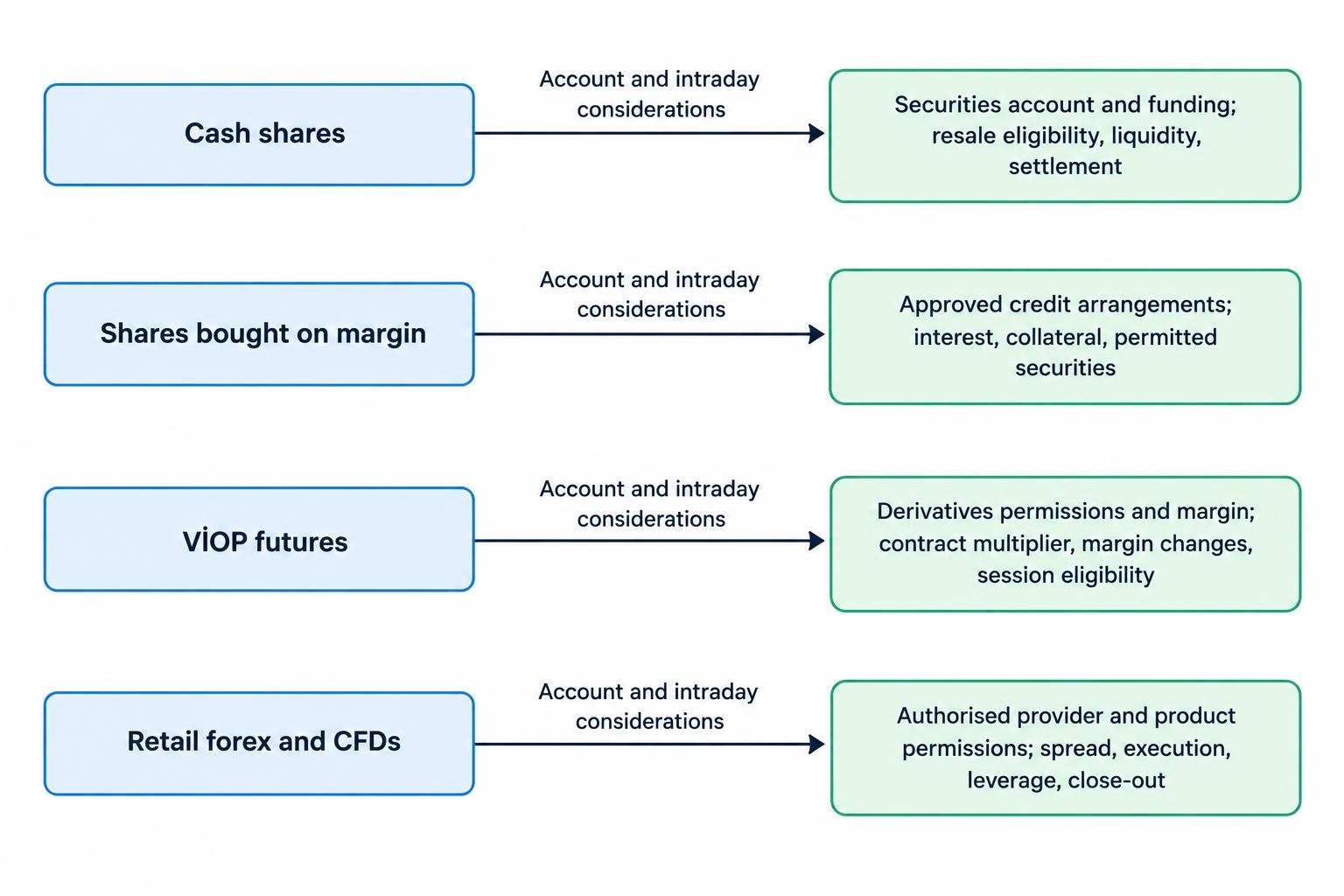
| Trading route | Main account requirement | Intraday issue to examine |
|---|---|---|
| Cash shares | Securities account and funding | Resale eligibility, liquidity and settlement restrictions |
| Shares bought on margin | Approved credit arrangements | Interest, collateral and permitted securities |
| VİOP futures | Derivatives permissions and margin | Contract multiplier, margin changes and session eligibility |
| Retail forex and CFDs | Appropriate provider authorisation and product permissions | Spread, execution, leverage and close-out terms |
Trading Hours, Settlement and Same-Day Resale
The Trading Session
For ordinary full trading days, the standard continuous trading period for many Borsa İstanbul shares is 10:00 to 18:00 Istanbul time, with opening procedures before it and closing procedures afterwards. The exchange’s trading timetable should be checked for the instrument and calendar date involved. Auctions operate differently from continuous trading: orders accumulate and are matched through an auction process, so submitting an order does not mean an immediate transaction. Instruments using a single-price method have a different trading rhythm again. A strategy built around five-minute bars needs to distinguish these phases. The apparent beginning or end of a chart bar does not establish when an order could have been entered, amended or filled under the relevant session rules.
VİOP has a separate schedule, and some contracts have an evening session. The exchange’s VİOP information page specifies which product groups participate and identifies calendar exceptions. A day trader using both equities and derivatives cannot assume that the markets open, close or respond to interruptions in exactly the same way. The broker’s own deadlines for reducing positions or adding collateral also need attention. For someone working from another country, the schedule must be converted into their local time, including changes caused by daylight saving elsewhere. A practical plan sets a latest time for new entries and a separate deadline for reducing exposure. Waiting until the last available moment to close leaves little room for rejected orders, partial execution or a connection problem.
Settlement Does Not Mean a Minimum Holding Period
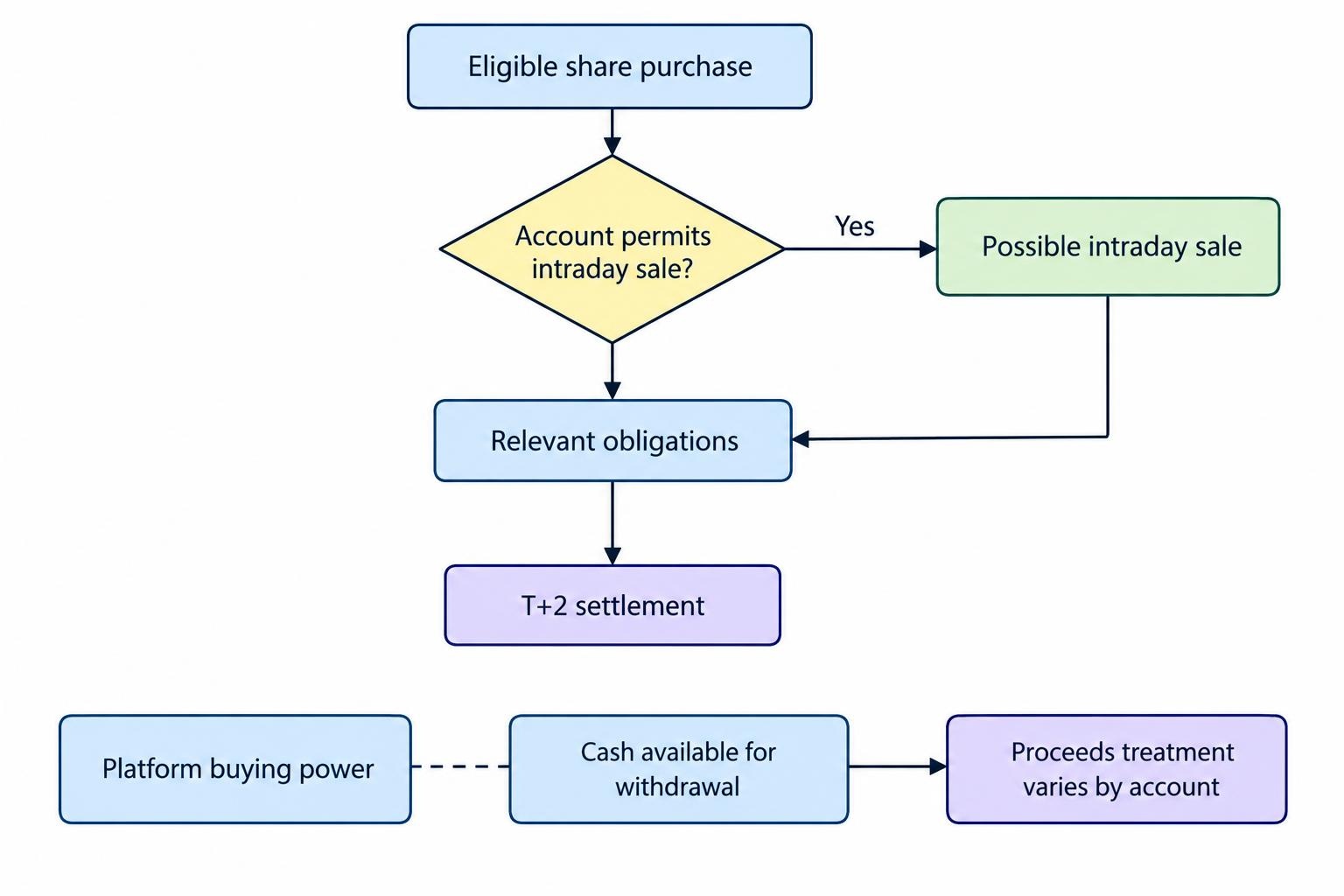
Borsa İstanbul’s equity settlement principles currently specify T+2 settlement, meaning the second business day after the transaction. That does not, by itself, require an ordinary eligible share purchase to be held for two days. Trading and settlement are related but separate processes. An account may permit an intraday sale while the corresponding cash and securities obligations settle later. Buying power displayed on a platform can consequently differ from cash available for withdrawal. The broker must explain how it treats sale proceeds, outstanding purchase obligations and any credit provided between trade and settlement. Repeatedly using the displayed balance without knowing what it represents can create a funding problem even when the trader finishes the session without an open market position.
Gross Settlement, Short Selling and Trading Halts
Gross settlement is a direct obstacle to some intraday strategies. Ak Yatırım’s account guidance explains that shares purchased under this measure cannot be sold on the same day and that purchases require existing cash. A trader who buys such a share expecting to exit a few minutes later has selected an instrument that conflicts with the plan. Eligibility must therefore be checked before order entry, rather than inferred from the fact that the platform accepts a purchase. Short selling introduces further conditions involving permitted securities, borrowing and current restrictions. Borsa İstanbul’s market functioning rules describe measures that can change margin access, short selling and order handling. A strategy needs to reflect the conditions applying to the security on the actual trading date.
Price limits and circuit breakers create a different constraint. Borsa İstanbul’s equity market FAQ describes both security-based and market-wide interruption mechanisms. These can pause the normal ability to trade, while a price limit can leave sellers waiting without enough buyers at the permitted price. Neither mechanism guarantees an exit at a trader’s chosen stop. An account can consequently carry exposure beyond the planned holding period, even when the trader submitted an instruction to sell. The relevant risk is not simply that the price moves quickly; it is that execution becomes unavailable or changes form. Position size should allow for that possibility, particularly in shares where liquidity is thin or selling pressure has already pushed the price close to its daily limit.
Choosing a Broker, Platform and Data Feed
Readers comparing the available tools can use DayTrading.com’s broker reviews and day trading guides to research platforms, pricing models and trading methods. For a Turkish account, that research should lead to direct checks of the contracting entity, permissions and current account terms. A broker appearing in an international comparison does not establish that it is authorised for every activity it advertises to Turkish residents. Reviews may also describe a different entity within the same corporate group. The useful comparison begins with providers that can lawfully supply the required service, then examines whether their systems support the intended trading frequency and order sizes. Attractive platform features have little practical value if the account cannot execute the strategy under the conditions assumed.
Market data deserve the same scrutiny as commission rates. A delayed quote is unsuitable for deciding whether to trade against a rapidly changing order book. The trader should know which data package is active, whether displayed prices are executable and whether depth information covers the relevant venue. A large visible order also does not promise that liquidity will remain available when another order arrives. For exchange-traded shares, bid and ask prices, recent trades and the queue at each level answer different questions. Watching only the last traded price can hide the immediate cost of entering or leaving. A platform that presents these distinctions clearly is more useful than one with many indicators but an unclear relationship between charts, quotes and order entry.
Order handling should be examined through actual confirmations and records. A market order prioritises execution against available liquidity, whereas a limit order controls its acceptable price and may remain unfilled. Borsa İstanbul’s published order rules use price and time priority for pending limit orders, so touching a level on a chart does not establish that every order at that price traded. Broker-provided conditional orders need further checking: the trigger may be monitored by the broker, and the resulting order must still satisfy market rules. The trader should know what happens after a partial fill, whether linked orders adjust automatically and how cancellation is confirmed. During an outage, an alternative contact or trading channel is useful only if its availability and procedures have been established beforehand.
The Cost of Repeated Intraday Trades
Commission and Turnover
Day trading repeatedly applies transaction costs to the same pool of capital. Consider ten completed trades producing TRY 1 million of combined purchase and sale turnover and TRY 1,000 of gross profit calculated from executed prices. At a hypothetical commission of 0.05% on traded value, commission totals TRY 500, leaving TRY 500 before other fees and taxes. The account did not need to contain TRY 1 million; the turnover could have been generated by repeatedly buying and selling smaller positions. This distinction explains why apparently modest commission rates can matter. The table uses invented rates to illustrate the calculation, not current quotations from Turkish brokers. Minimum charges, exchange-related costs and the treatment of separate fills can change the effective cost.
| Hypothetical commission on traded value | Combined purchase and sale turnover | Total commission | TRY 1,000 gross profit after commission |
|---|---|---|---|
| 0.02% | TRY 1,000,000 | TRY 200 | TRY 800 |
| 0.05% | TRY 1,000,000 | TRY 500 | TRY 500 |
| 0.10% | TRY 1,000,000 | TRY 1,000 | TRY 0 |
Spread and Slippage
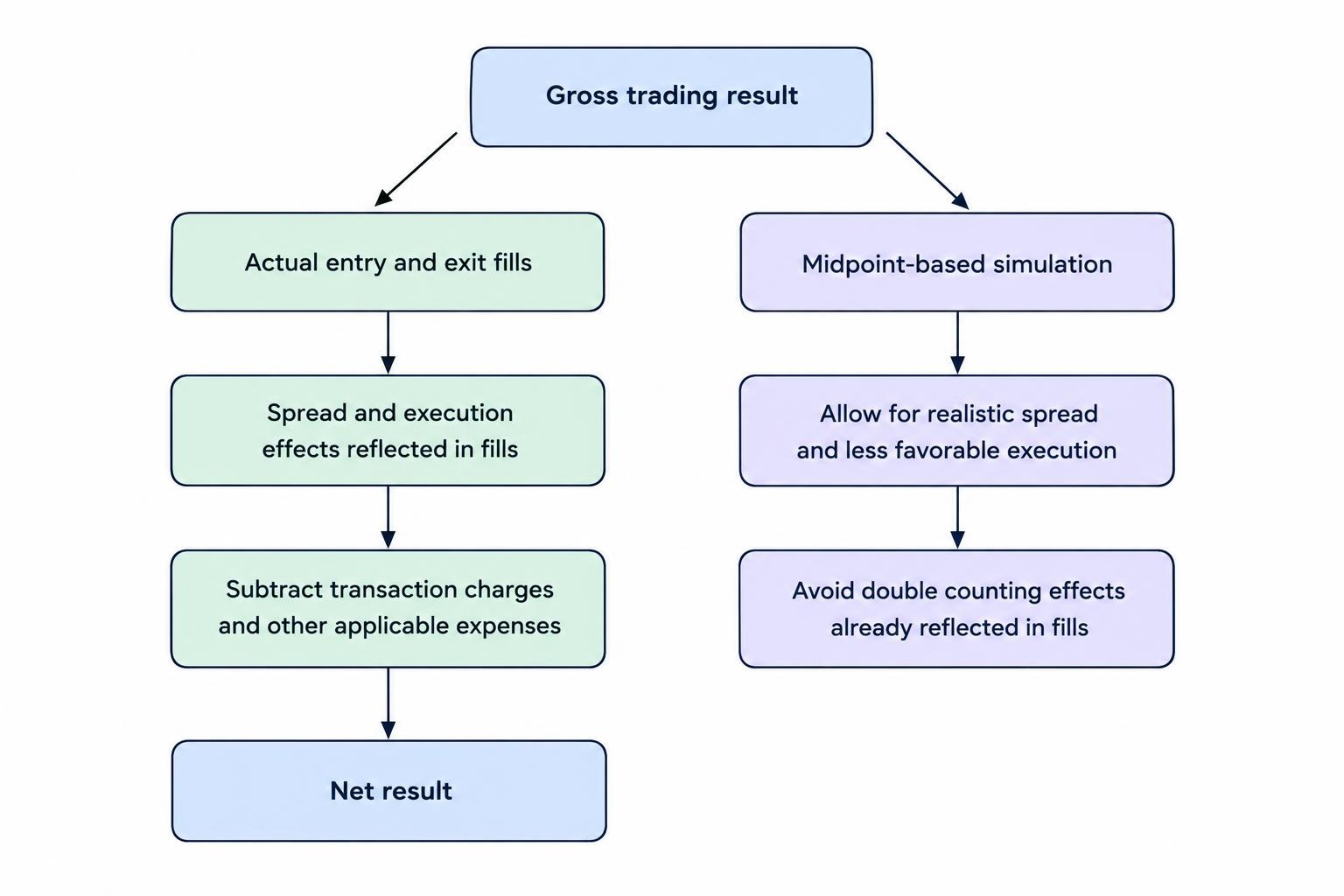
The spread is the difference between the price available to buy and the price available to sell. A trader who repeatedly crosses that difference needs enough favourable movement to recover it before earning a net trading gain. Slippage adds the difference between an assumed or requested price and the actual fill. Both become more consequential when profit targets are small. However, cost analysis should avoid double counting. If a trading record already calculates profit from actual entry and exit fills, the effects of spread and execution are embedded in those prices. They should not then be subtracted again as though absent from the result. A simulation based on midpoint prices, by contrast, needs a realistic allowance for crossing the spread and for less favourable execution.
Funding and Fixed Expenses
A position held only briefly can still incur costs beyond commission. Share credit, borrowing arrangements or product fees may have charging conventions that do not disappear because the position was closed before the session ended. Forex and CFD financing depends on the provider’s cut-off and contract terms, rather than the trader’s own definition of overnight. Market data subscriptions, charting software and connectivity create fixed expenses as well. These should be allocated when evaluating whether the activity produces a worthwhile net return. A strategy earning a small amount before monthly subscriptions can become unprofitable after them. Currency conversion can add another expense when funding, trading and withdrawals use different currencies. The full account statement is therefore a better basis for evaluation than a platform’s prominent gross profit figure.
Intraday Strategies and Their Limitations
Opening Range Breakouts
An opening range strategy defines the high and low of a chosen early-session period and looks for a move beyond that range. A research version might use the first 15 or 30 minutes of continuous trading, with separate rules for entry, failure and exit. Those periods are examples to test rather than universally effective settings. In Turkish shares, the opening auction and any interruption can change what the early price sequence represents. A breakout accompanied by unusual activity may reflect new information, but it can also reverse after the initial order imbalance is absorbed. The test must allow for the price actually available after the trigger. Assuming an entry exactly at the range boundary can materially overstate results when the market moves through it quickly.
Pullbacks and VWAP
A trend-following intraday approach waits for an initial directional move and then looks for a smaller counter-move before entering. Volume-weighted average price, or VWAP, can provide a reference by weighting traded prices by their associated volume over the selected period. Trading above it does not establish that further gains are likely, and a return to it does not guarantee support. The definition used by the platform also matters, including which session and trades enter the calculation. A testable method needs conditions beyond a visual impression that price is strong. It should state how the trend is identified, what qualifies as a pullback and what would invalidate the setup. Without those rules, the same chart can be interpreted differently after each outcome.
Range Trading and Mean Reversion
Mean reversion strategies attempt to profit when a short-term deviation reverses towards an earlier trading area or reference price. Their main vulnerability is a session in which new information causes persistent repricing. A share that has already fallen sharply can continue falling, especially if the original reason for the move has not been understood. In Turkey, company disclosures, monetary policy developments and currency movements can affect several related securities at once. Buying every apparently stretched decline is therefore not the same as applying a tested range strategy. The method needs a clear condition for abandoning the expectation of a return, together with a limit on repeated entries. Adding to a losing trade because its price is further from the reference can increase exposure precisely when the original assumption is failing.
Position Size and Daily Loss Limits
A position calculation should begin with an assumed loss amount and a plausible exit distance. Suppose a hypothetical account holds TRY 100,000 and the trader allocates TRY 200 of price risk to one trade. Buying at TRY 100 with an intended exit at TRY 99.60 gives TRY 0.40 of price risk per share, implying 500 shares before allowing for costs. The purchase value is TRY 50,000, so half the account is deployed even though the intended price loss is 0.2% of account value. Commission, slippage and a delayed exit can make the realised loss larger. This example illustrates the distinction between capital committed and planned loss; it does not establish that either amount is suitable. Derivatives require the same calculation using their contract multiplier and minimum tradable size.
A daily loss limit addresses the accumulation of mistakes and unsuccessful trades across a session. It should include realised losses, open exposure and trading costs, rather than counting only closed losing positions. Once the limit is reached, attempting to recover it through larger orders changes the risk plan at the point when execution or judgement may already be deteriorating. Related positions also need to be considered together. Several bank shares can respond to the same development, while an index contract may repeat exposure already held through equities. A limit is a decision rule, not a guarantee against a larger loss during a halt or sharp move. It is most useful when the trader can explain in advance how positions and outstanding orders will be handled after it is triggered.
News, Liquidity and Lira Exposure
Intraday preparation in Turkey should include KAP’s company disclosures, relevant corporate events and the economic calendar. A headline can move prices before a retail trader has read the underlying announcement, so speed alone is not a reliable advantage. The useful task is to distinguish an event that changes the trading conditions from information that has already been absorbed. Earnings, financing arrangements and capital actions can affect both price and liquidity. Monetary policy and inflation releases can change the behaviour of whole sectors. When a trade depends on a narrow exit distance, the time of a scheduled announcement becomes part of the setup. Continuing to use ordinary-session assumptions during an event can understate both the likely spread and the possible execution delay.
Finishing the day without shares or futures does not necessarily remove currency exposure from the account. A foreign investor who retains the proceeds in lira still holds an asset whose value changes against their reporting currency. Conversely, a Turkish resident trading in dollars may see lira account value change partly because of translation rather than trading performance. The record should distinguish those effects. As a hypothetical example, a 1% lira trading gain combined with a 2% rise in USD/TRY produces a dollar return of approximately 1.01 divided by 1.02, minus one, or negative 0.98%, before costs. Converting after every transaction is not automatically an efficient response because conversion itself can be expensive. The account’s currency policy needs to be evaluated alongside the trading strategy.
Offshore Platforms and Foreign Markets
An overseas account introduces legal and operational questions that cannot be resolved by its website accepting a Turkish address. Article 9 of the Treasury communiqué under Decree No. 32 addresses foreign securities and derivatives transactions. Its second paragraph separately requires Turkish residents’ leveraged transactions and derivatives governed by the same provisions to pass through SPK-authorised institutions, and prohibits overseas transfers for the unauthorised transactions it covers. The fact that positions are closed intraday creates no general exemption. Foreign share ownership and offshore leveraged forex should also not be treated as the same activity. Residence, product classification, intermediary and funding route determine the questions that need answering before the account is used.
A foreign-market strategy can also depend on arrangements that are absent from a domestic account. Different settlement cycles, margin treatment, short-selling access and market-data permissions can change how frequently capital may be reused or which orders are accepted. Tutorials written for one jurisdiction should therefore be read as descriptions of that setting, rather than universal instructions. A Turkish citizen resident abroad may face a different position from a foreign citizen resident in Turkey. The legal entity serving the account can matter as much as the market whose prices appear on screen. For a trader considering an overseas provider, the practical requirement is a documented account structure and an explanation of the applicable rules, rather than an assumption that a familiar international brand supplies the same service everywhere.
Testing, Record Keeping and Profitability
Testing an intraday method requires data detailed enough to reproduce its decisions. Daily price bars cannot establish the sequence of two levels reached within the same session, and even a minute bar can conceal whether a target or stop was reached first. Simulations should account for spread, commission, partial fills and restrictions that would have prevented an assumed transaction. A limit order should not automatically be treated as filled merely because a historical trade touched its price. Results also need a separate testing period, so that repeated adjustments do not simply fit the available sample. Paper trading can help identify operational errors, but it may represent queue position and execution more favourably than a live account. The gap between simulated and realised results should be measured.
Daily records should reconcile orders, executions, fees and cash movements. The account’s closing position matters alongside its reported profit: an unnoticed residual holding or active order can create exposure after the trader believes the session is finished. MKK’s e-Investor service can help monitor relevant accounts and transactions recorded in its systems, while broker statements provide the detailed basis for reconciliation. Tax records should preserve realised transactions, charges, distributions and any withholding. Treatment depends on the instrument, investor and jurisdiction, rather than the use of the phrase day trading. Keeping these records also makes it possible to identify whether poor results arise from the method, execution, excessive costs or repeated departures from the written plan.
Profitability should be assessed across enough trades and changing conditions to expose more than a favourable run. A hypothetical strategy winning half its trades, earning TRY 300 on each winner and losing TRY 200 on each loser has an average gross result of TRY 50 per trade. If average total costs are TRY 60, its average net result is negative TRY 10 despite the larger winning trades. Real outcomes also include unusually large losses and periods when the strategy stops working. Turnover, trade count and the number of profitable days do not establish a sustainable income. The relevant evidence is net return after expenses, the depth of losses along the way and whether the activity remains workable without increasing exposure to meet a desired earnings target.