Forex trading in Turkey is legal through authorised firms, but the rules for leveraged retail trading are more restrictive than the terms advertised by many international brokers. The domestic framework governs who may provide the service, how accounts are opened and how much exposure traders can take against their collateral. Those rules matter before any comparison of spreads, platforms or currency pairs. A Turkish website, local telephone number or payment account does not establish that a provider has permission to offer forex trading to Turkish residents. Equally, a licence issued elsewhere does not automatically authorise that business in Turkey. The practical starting point is the trader’s residence, the legal entity offering the account and the product being traded, rather than the broker’s brand or the language of its advertising.
The word forex also needs some precision. Buying dollars through a bank, holding a foreign currency balance and opening a leveraged EUR/USD position are different transactions. In the retail brokerage market discussed here, traders generally enter contracts whose gains and losses follow exchange rates without taking delivery of the underlying currency. İş Yatırım’s leveraged trading risk disclosure describes these as over-the-counter derivative transactions. That structure creates exposure to market prices, financing charges and the broker’s execution arrangements. Someone wanting dollars for future spending may therefore need a currency account rather than a speculative trading account. Someone trading EUR/USD from Turkey, meanwhile, is participating in a global currency market even though neither side of the pair is the Turkish lira.
Is Forex Trading Legal in Turkey?
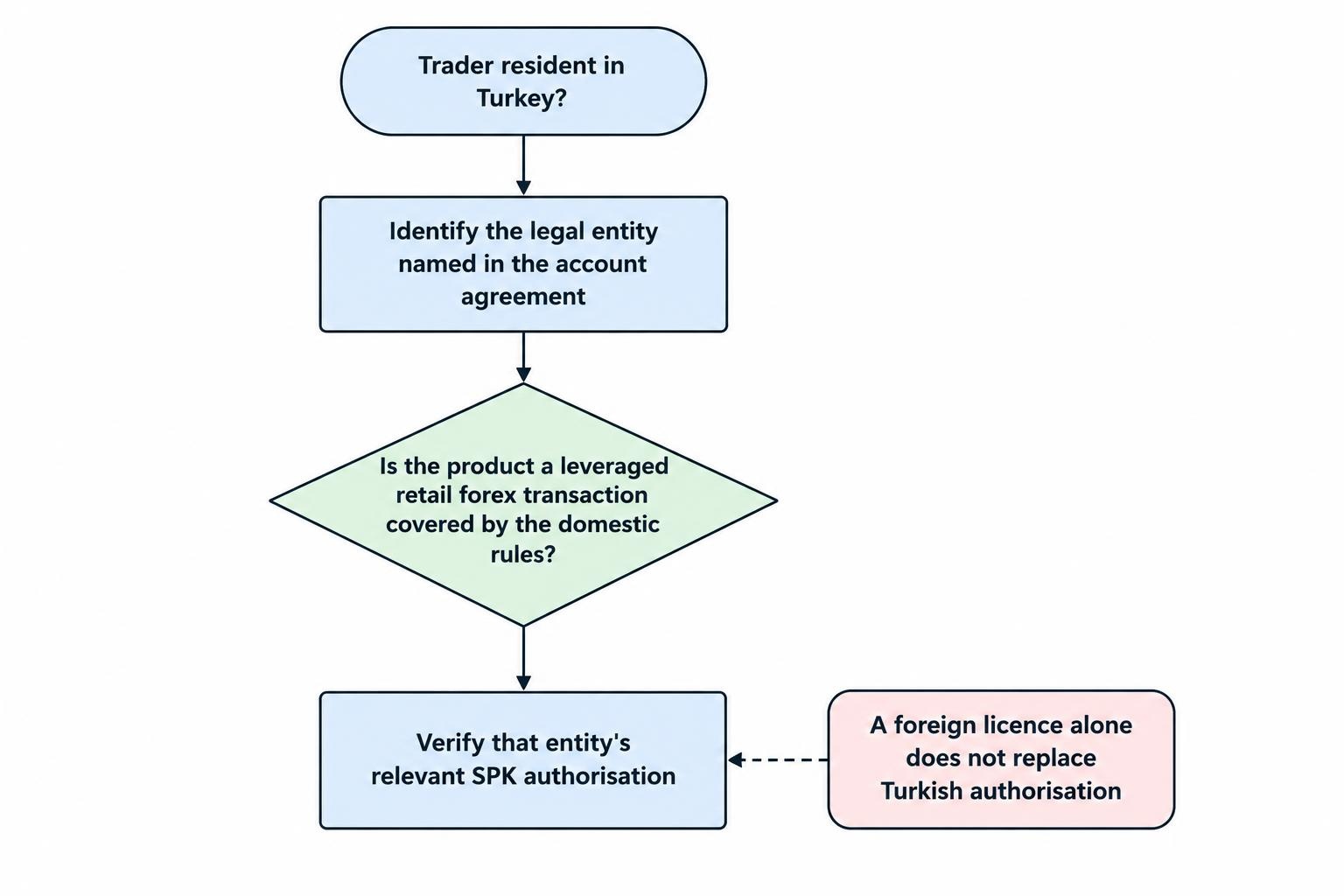
Turkey’s Capital Markets Board, known locally as the Sermaye Piyasası Kurulu or SPK, regulates retail leveraged forex services. Its warning on unauthorised leveraged trading states that investors resident in Turkey must conduct these transactions through institutions authorised by the board. This makes the provider’s permission central to the transaction. A company authorised for one investment activity should not be assumed to have permission for every other activity, and a foreign regulator’s approval does not replace the Turkish authorisation requirement. The distinction is especially relevant where an international brand operates several companies. Its website may display licences held across the group, while the account agreement assigns the customer to just one entity. The permissions of that contracting entity determine the regulatory position of the account.
The foreign exchange rules reinforce that restriction. Article 9(2) of the Treasury’s communiqué under Decree No. 32, amended in March 2025, reserves residents’ leveraged transactions and derivatives subject to the same provisions to SPK-authorised institutions, and prohibits overseas transfers for the unauthorised transactions covered by that paragraph. The neighbouring provision allowing certain overseas derivatives transactions on a resident’s own initiative should not be read as a general exemption for retail forex. Residence is also different from citizenship or the currency being traded. A Turkish citizen living abroad and a foreign citizen resident in Turkey may face different circumstances. Likewise, trading USD/TRY from another country does not, simply because the pair contains lira, place the account within Turkey’s domestic retail brokerage system.
Minimum Deposit and Account Opening Requirements
The domestic rules set a minimum initial collateral requirement of TRY 50,000, or its foreign currency equivalent, and a maximum leverage ratio of 10:1. These conditions were introduced in the SPK’s February 2017 amendment and remain reflected in current domestic broker terms. The threshold is denominated in Turkish lira; it is not a fixed US dollar minimum. Its equivalent in another currency changes with the conversion rate used. It is also an entry requirement, not a finding that the amount is suitable for a particular person or strategy. An account funded at the minimum can still be too small for the position size, stop distance or expected drawdown a trader has in mind. The minimum permitted trade size therefore deserves attention before funding.
Retail onboarding also includes a demo trading requirement. Peker Menkul’s account information describes at least six business days of practice and at least 50 demo transactions before live forex trading. This period can be used to check order entry, position sizing and how the platform displays margin, rather than simply completing the transaction count. A useful simulation uses a balance and trade sizes close to those intended for the live account. Results obtained with an oversized virtual balance say little about how a smaller funded account will behave. Identity verification, account agreements and risk disclosures also need to be completed under the provider’s process. The applicable documents should explain funding currencies, conversion arrangements and trading permissions, with any unclear terms resolved before the first deposit.
How the 10:1 Leverage Limit Works
Exposure and Account Risk
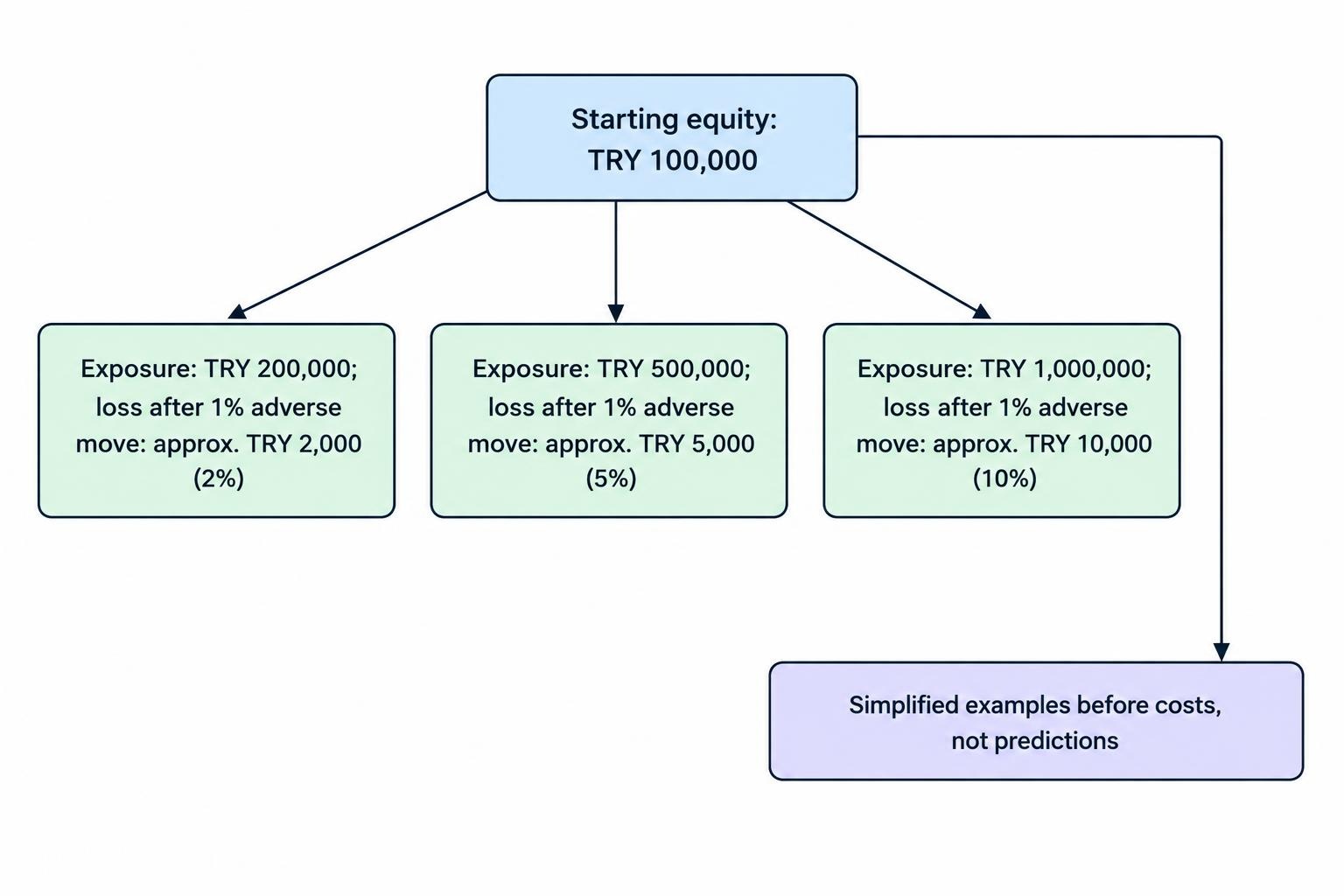
A maximum ratio of 10:1 means that a position can require collateral equal to at least one tenth of its value, subject to the broker’s applicable terms. It does not mean that every trader must use the maximum exposure available. An account holding TRY 100,000 equivalent with positions worth TRY 200,000 equivalent has effective exposure of roughly twice its equity. The same account with TRY 1 million equivalent in positions has exposure of roughly ten times its equity. Profit and loss arise from the positions, while the account must absorb the result. Brokers can also impose lower ratios on individual pairs. When checked in October 2026, Destek Yatırım’s published contract table showed 3:1 for USD/TRY and EUR/TRY. The national ceiling therefore does not establish the margin requirement for every available contract.
Consider the simplified examples below, all using TRY 100,000 of starting equity and an assumed 10% initial margin requirement. The calculation treats the exposure as one position and holds the conversion into the account currency constant. A 1% adverse price move on TRY 500,000 of exposure produces approximately TRY 5,000 of loss before costs, which is 5% of starting equity. Increasing exposure to TRY 1 million doubles that loss without requiring a larger market move. These figures are illustrations, not predictions of what a currency pair will do. They also exclude spread, commissions, financing and any change in the exchange rate used to translate profits and losses. Actual contract calculations can differ, particularly when the account currency is neither currency in the traded pair.
| Starting equity | Position value | Initial margin at 10% | Approximate loss after a 1% adverse move | Loss as share of starting equity |
|---|---|---|---|---|
| TRY 100,000 | TRY 200,000 | TRY 20,000 | TRY 2,000 | 2% |
| TRY 100,000 | TRY 500,000 | TRY 50,000 | TRY 5,000 | 5% |
| TRY 100,000 | TRY 1,000,000 | TRY 100,000 | TRY 10,000 | 10% |
Margin Calls and Forced Closures
Margin is collateral supporting the trade; it is not a prepaid maximum loss. As open positions lose value, equity falls and the remaining margin buffer shrinks. A broker can close positions when its contractual close-out threshold is reached, potentially before the trader expects the market to recover. Turkey’s investment services communiqué requires the framework agreement to address collateral calculations, margin calls, automatic closure and currency conversion. Those details should be checked at the account level rather than inferred from the national leverage cap. Funding the account exactly to its theoretical maximum position size also leaves no opening buffer for spread or fees. A trade can therefore create immediate pressure on available margin even when the underlying exchange rate has barely moved.
Currency Pairs and the Turkish Lira
Trading from Turkey does not require trading the lira. A domestic broker may offer major pairs such as EUR/USD alongside other currencies and instruments, although the available contracts depend on the provider. Destek Yatırım’s product overview, for example, describes a platform covering currencies as well as metals, commodities and CFDs. Those categories should remain separate when assessing a strategy. Gold quoted in dollars is not a currency pair, and an equity index contract responds to different influences from EUR/USD. Even within currencies, EUR/USD, USD/JPY and USD/TRY have different quoting conventions, funding costs and patterns of liquidity. A platform with more symbols is useful only if the contracts needed for the intended approach have workable sizes, prices and trading conditions.
USD/TRY expresses the number of lira required to buy one US dollar. A rise means that the dollar has strengthened against the lira; a fall means that the lira has strengthened against the dollar. That relationship is simple, but the return from a leveraged position is more involved. Financing charges can accumulate while the trade remains open, and an adverse move can cause a forced closure before a longer-term forecast is realised. A trader can correctly anticipate eventual lira depreciation and still lose money through entry timing, position size or holding costs. EUR/TRY adds another source of movement because changes in the euro against the dollar can affect the pair alongside changes in the lira. Treating all lira pairs as interchangeable can therefore produce a misleading picture of exposure.
For lira trading, central bank policy, inflation expectations, external funding conditions and changes in market confidence all deserve attention. The CBRT’s Monetary Policy for 2026 states that the bank has no commitment to a particular exchange rate level, while retaining measures and instruments to support market functioning. That statement should not be converted into an assumption that exchange rates will move smoothly or that policy cannot affect liquidity. The price of a currency reflects expectations about future conditions as well as current data. A widely anticipated interest rate decision can produce less movement than an unexpected change in guidance. For a trader, the useful comparison is between the announcement and what the market appeared to expect before it, with position size allowing for an imperfect reading of both.
Spreads, Commissions and Overnight Costs
Comparing the Cost of a Trade
The spread is the difference between the buying and selling price available at a given moment. Some accounts charge mainly through that difference; others combine a narrower spread with an explicit commission. A claim of spreads “from zero” describes a possible minimum, rather than the cost a trader should expect across an entire session. The comparison needs the same currency pair, position size and trading period. It should also distinguish a commission charged on each side from one quoted for opening and closing combined. A broker advertising a lower spread can cost more after commission, while a wider spread can be acceptable if other charges are lower. Neither pricing format proves better execution, and neither establishes that the provider is authorised to serve the customer.
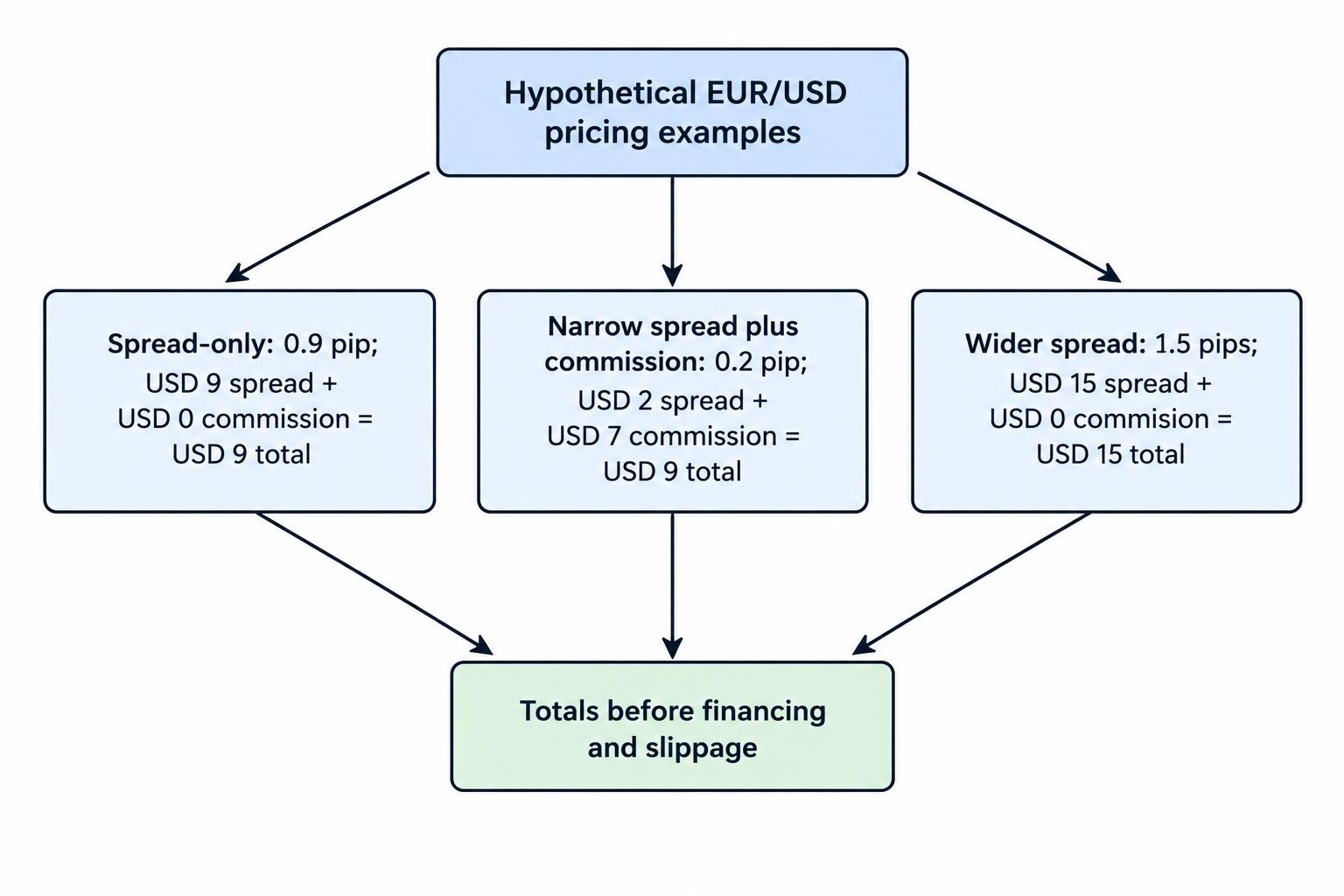
For a worked comparison, assume an EUR/USD contract of 100,000 euros, where a movement of 0.0001 dollars per euro represents USD 10. An assumed 0.9-pip spread would then cost about USD 9 for an immediate opening and closing at unchanged quotes. A 0.2-pip spread would represent about USD 2, but adding USD 7 of total commission produces the same USD 9 cost. The table uses invented prices to show the arithmetic; it does not describe current offers from Turkish brokers. It also assumes no slippage and excludes overnight charges. For a strategy aiming to capture only a few pips, a difference of one dollar per trade can become material over repeated transactions. For a position held for several weeks, financing may matter far more.
| Hypothetical pricing model | Spread | Spread cost on the assumed contract | Commission for opening and closing | Total before financing and slippage |
|---|---|---|---|---|
| Spread only | 0.9 pip | USD 9 | USD 0 | USD 9 |
| Narrow spread plus commission | 0.2 pip | USD 2 | USD 7 | USD 9 |
| Wider spread, no commission | 1.5 pips | USD 15 | USD 0 | USD 15 |
Financing and Currency Conversion
Positions held across the broker’s daily rollover can incur a financing debit or credit, commonly labelled swap. The amount depends on the contract, direction, rate schedule and holding period, and it should be checked separately from the spread. Domestic brokers publish relevant information through pages such as Destek Yatırım’s trading costs disclosure. A favourable interest rate difference does not guarantee a favourable retail credit after pricing adjustments. Accounts described as swap-free also need their full fee terms examined, including any administration charges or time restrictions. Conversion charges can create another layer when deposits, trading results and withdrawals use different currencies. A realistic cost estimate therefore follows the entire transaction from funding to withdrawal, rather than stopping at the quoted price of the currency pair.
Finding Forex Brokers for Turkey
When researching providers for Turkey, ForexBrokersOnline’s forex broker reviews and comparisons can serve as a starting point for building a shortlist. Its broker information can help readers compare platforms and trading conditions before investigating an account directly. The next step is to establish whether the firm currently accepts the trader’s residence and whether the proposed entity has the permissions required to serve that person. A broker appearing on a comparison website is not, by that fact, an SPK-authorised Turkish broker. Nor does an account application accepting a Turkish address settle the legal position. These checks are particularly relevant when a brand operates through several jurisdictions, because the conditions shown in a general review may belong to a different entity or account category.
Authorisation should be checked against the SPK’s intermediary institution register, using the full company name in the agreement. The broker should also be able to identify its permission for leveraged transactions and explain which entity receives and holds the customer’s funds. Domain names, contact details and payment instructions should be consistent with that identity. An imitation website can reproduce a real company’s name or licence details without having any connection to it, so matching a name alone is insufficient. Contacting the firm through details obtained independently from its official records provides a stronger check. For an international group, the customer should keep the agreement naming the actual counterparty rather than relying on a footer listing several regulators without explaining which one covers the account.
Once the legal position is established, comparison can move to the terms that affect actual trading. A trader using small positions needs suitable minimum contract sizes and increments. Someone holding positions overnight needs a usable financing schedule. Someone trading around announcements needs clear information about order handling and how execution complaints are investigated. The ability to export statements, review transaction history and reach support during the relevant trading hours also has practical value. These features are easier to assess through a demo account and written responses than through a ranking badge. A broker may be a workable choice for occasional EUR/USD transactions but a poor fit for frequent lira trading. The appropriate comparison is therefore between providers offering the same required activity under terms the trader can document.
Trading Platforms, Orders and Execution
A familiar platform can make the mechanics of trading easier, but the software’s name says little about the legal status or financial condition of the company supplying the account. The broker determines the offered contracts and publishes the account’s trading conditions. The demo period should therefore include practical checks of contract size, price increments, chart time and the relationship between order volume and cash exposure. A chart displaying a bid price can also look different from the price used to trigger an order governed by the ask. Without checking that distinction, a trader may interpret an ordinary spread effect as a pricing error. The most useful platform is one whose behaviour the trader can explain, including how pending orders, partial closures and account statements represent the underlying transactions.
Execution becomes more difficult when prices change rapidly or available liquidity falls. A market order seeks execution at available prices, while a limit order sets a price condition and may remain unfilled. An ordinary stop order does not necessarily guarantee the final execution price. İş Yatırım’s risk notification discusses the risks of adverse market conditions and order execution, which are relevant when evaluating any promise of precise fills. For practical assessment, the trader needs time-stamped order records, the requested price and the eventual fill, together with the applicable bid and ask where available. A few favourable trades cannot establish reliable execution quality, just as one slipped order does not establish misconduct. The pattern and the contractual explanation both matter.
Deposits, Withdrawals and Client Money
Domestic forex collateral sits within a reporting and custody framework involving Takasbank. Its leveraged trading collateral procedures describe customer-based monitoring and the reporting of collateral and transactions by authorised institutions. This creates records beyond the trading platform itself, but it does not remove market losses or turn the account into an ordinary guaranteed bank deposit. Before funding, the customer should understand how collateral information can be checked and how reporting times relate to the balance shown on the platform. Deposit instructions should come through verified company channels, with records of the recipient, amount and reference retained. A payment request sent by a salesperson should be reconciled with the institution’s published instructions before money is transferred.
Withdrawals also need to be considered alongside open positions and margin requirements. Money shown as account equity may include unrealised gains or amounts supporting existing exposure, so it may not all be available for immediate transfer. Timing, conversion charges and documentary checks should be explained in the account terms. Where a firm fails to meet eligible payment or delivery obligations, Turkey’s Investor Compensation Centre operates under an SPK compensation decision and the relevant statutory framework. That role should not be confused with reimbursement for an unsuccessful trade, nor should coverage of a particular claim be assumed without checking the rules. Keeping agreements, payment confirmations and statements outside the broker’s platform makes it easier to establish what was deposited, traded and requested if a dispute later develops.
Are Turkish Forex Traders Going Offshore?
There is documented activity involving unauthorised overseas forex providers, alongside a functioning domestic market. The SPK’s bulletin dated 10 April 2025 records action to seek access blocking for websites found to provide unauthorised overseas leveraged trading to Turkish residents. That is evidence of a real enforcement issue, but it does not establish the number of customers involved or their share of the market. Higher advertised leverage, smaller starting deposits and different platform offerings are plausible reasons some traders consider overseas accounts. They should be treated as possible incentives, rather than findings from a representative survey. A foreign firm can also be regulated in its home jurisdiction while lacking permission for the activity it offers to residents of Turkey. Foreign regulation and Turkish authorisation answer different questions.
Domestic data give a more measurable, though incomplete, view. The Turkish Capital Markets Association’s October 2026 bulletin reports 14,725 accounts active in leveraged transactions for August 2026, as indicated by the table’s reporting footnote. The count can include the same person at more than one institution, and the leveraged transaction category should not be treated as a count of people trading currency pairs alone. It also does not measure the offshore population. Those limitations prevent a defensible claim that most Turkish forex traders use either domestic or overseas accounts. The evidence supports a regulated local market and an unauthorised cross-border market existing at the same time. It does not support a reliable percentage split, or the assumption that widespread online advertising means widespread legal access.
Position Sizing, Records and Performance
A trading plan becomes useful when it translates a market view into a cash amount at risk. Suppose a trader chooses an illustrative loss budget of TRY 1,000 for one position and identifies a stop distance equivalent to a 0.5% move. Ignoring costs and conversion effects, exposure of roughly TRY 200,000 would produce that loss if the stop executed at the intended level. Spread, financing and possible slippage require further allowance, and a stop cannot make the loss budget certain. This calculation works from the planned loss towards position size. Starting with the maximum exposure the platform permits can produce a position that has little relationship to the trade’s logic or the account’s capacity to absorb an error. The numerical budget is a scenario assumption, not a suitable amount for every trader.
Several positions also need to be examined together. Buying EUR/USD and GBP/USD can create overlapping exposure to dollar weakness, even though the symbols differ. Adding another pair does not necessarily diversify the account, and correlations can change during stressed markets. A useful record therefore includes the combined currency exposure as well as the result of each ticket. Performance should separate trading gains from deposits, and it should account for spread, commission, financing and conversion. If an account is measured in dollars while the trader’s spending is mainly in lira, both measures may be relevant. A rise in the lira value of a dollar account can reflect currency translation even when the trading strategy itself has made no profit. Mixing those effects makes evaluation less informative.
Tax and reporting questions should be resolved from the trader’s actual residence, account entity and transaction records. The presence of a broker in Turkey, the use of a Turkish bank account or the currency shown on the statement does not by itself establish the full treatment of the customer’s income. Obtain documentation of any deductions and use the relevant tax authority guidance or an adviser for the circumstances involved. Records should be detailed enough to reconstruct each realised result and distinguish it from transfers between accounts. Reviewing those records over time also shows whether the strategy remains viable after costs and periods of loss. The practical test is whether the account delivers an explainable result within the intended risk budget, through a provider authorised for the activity, with funds and transactions that can be reconciled.